
Procurement and technical teams rarely assess the terbium element as a standalone input. In operational practice, terbium appears as a heavy rare earth issue that starts in geology, becomes visible in separation chemistry, and finally matters in magnet or phosphor qualification. That sequence is the main reason supply analysis around terbium often looks different from analysis around copper, nickel, or other bulk materials. The relevant constraint is usually not mining volume alone. It is the combination of ore type, heavy rare earth distribution, solvent extraction capability, regulatory exposure, impurity control, and downstream qualification into a usable form.
- Terbium is a heavy rare earth typically assessed as part of a broader heavy rare earth stream rather than as an isolated mine output.
- Terbium and dysprosium usually travel together in supply analysis because they occur in similar deposits, pass through related separation circuits, and serve overlapping magnet functions.
- Two demand anchors matter most in practice: green phosphors and NdFeB magnet additives used to improve high-temperature performance.
- Southern China remains central because ion-adsorption clay resources and a large share of the separation ecosystem sit in the same supply architecture.
- Substitution and recycling are real but partial; both moderate exposure in some applications without removing the dependence on primary heavy rare earth supply.
What terbium is in supply-chain terms
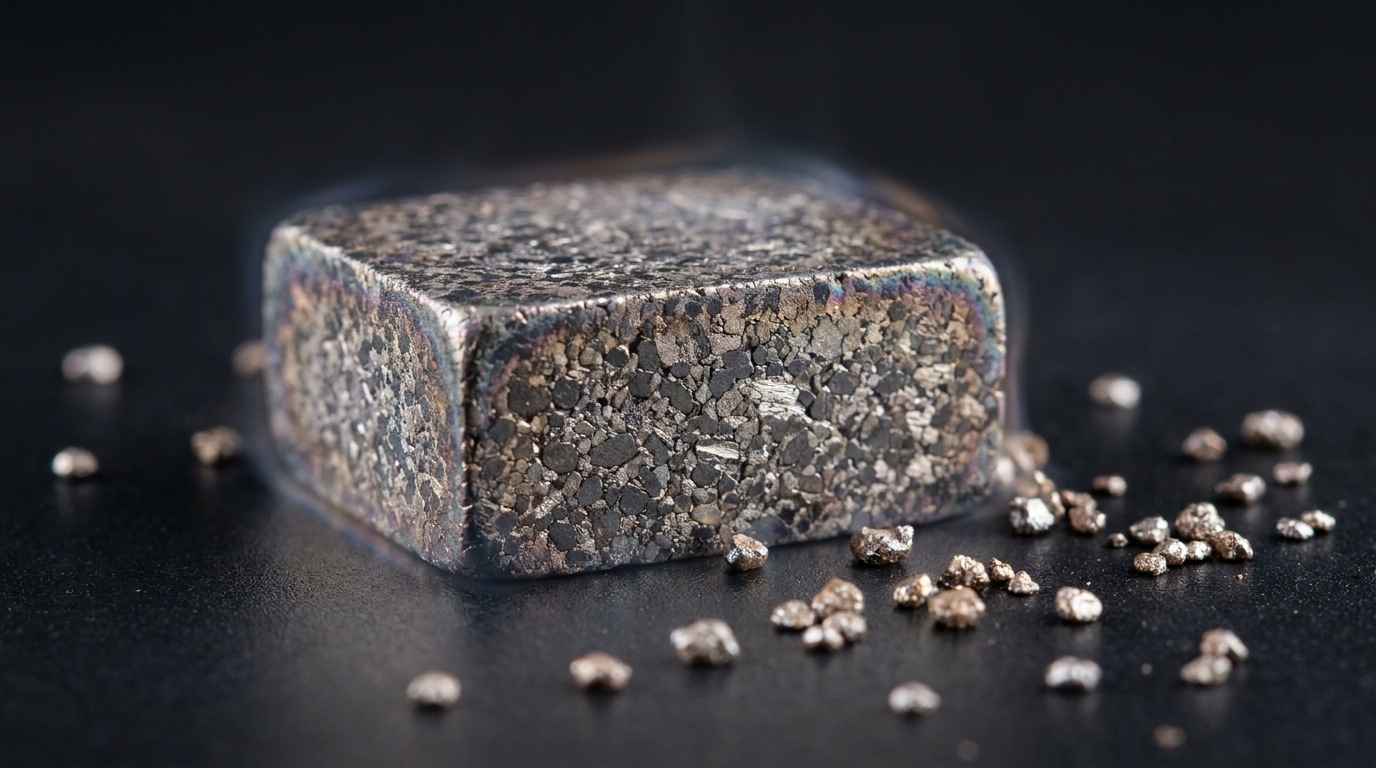
Terbium, symbol Tb, is a lanthanide and is generally classified as a heavy rare earth. In commercial discussions, the relevant product is rarely pure metallic terbium in a simple commodity sense. The market usually revolves around terbium oxide, chemical intermediates, metal, alloy additions, or magnet-related feedstock. That distinction matters because the tradable and usable form is created through technically demanding midstream steps, not simply by extracting ore.
From an application perspective, the two uses that repeatedly shape risk discussions are green phosphors and magnet additives. In phosphor chemistry, terbium is valued for its luminescent properties, especially where precise green emission is required. In magnets, terbium is used in small quantities to improve coercivity and thermal stability in NdFeB systems. The magnet role is especially visible in electric vehicles, wind turbines, industrial motors, robotics, and some defense-adjacent applications where performance under heat becomes a design constraint.
Why terbium and dysprosium are usually analyzed together
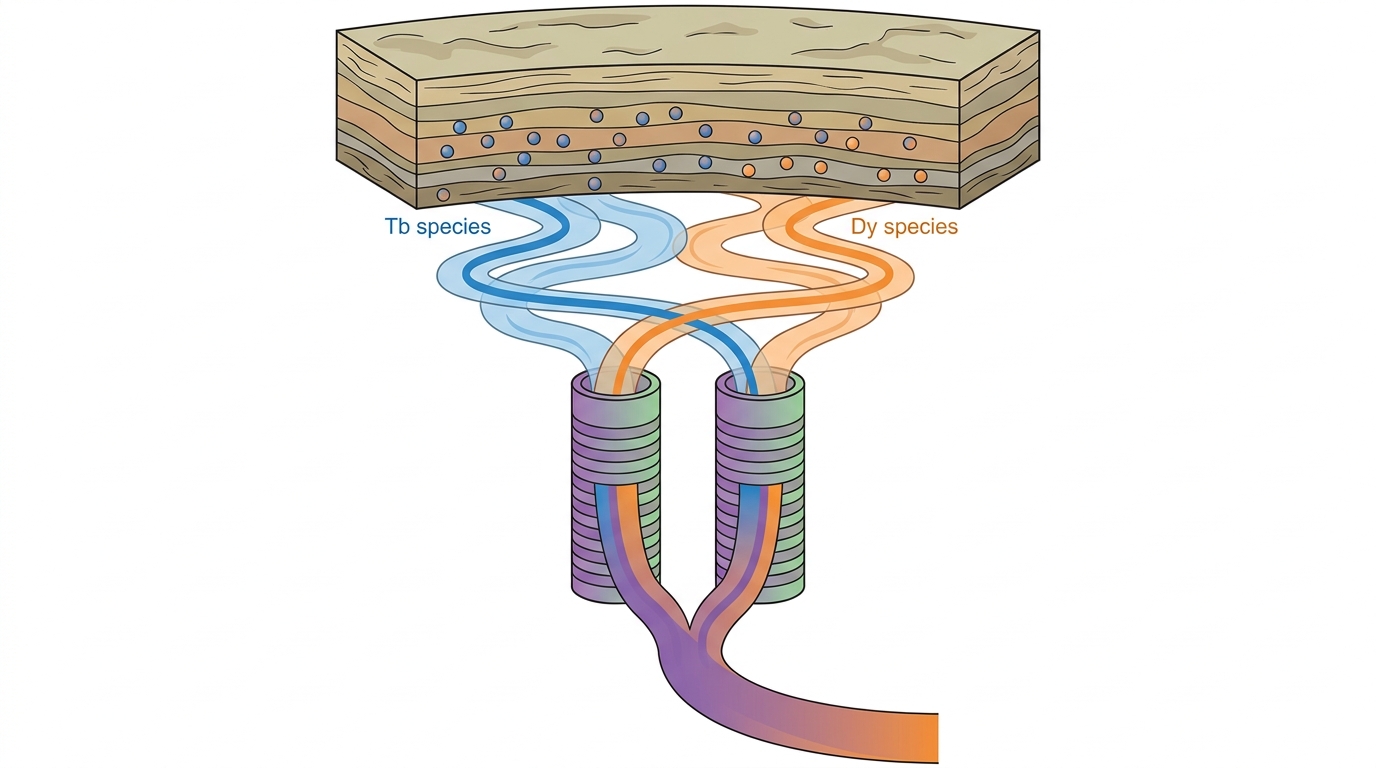
A recurring discovery moment in heavy rare earth work is that a “terbium issue” often turns out to be a dysprosium-and-terbium issue. The pairing starts in geology. Tb and Dy are commonly associated with heavy rare earth-bearing deposits, especially ion-adsorption clays in southern China and some clay or carbonatite systems elsewhere. The pairing continues in processing because both elements move through related separation circuits and refining flows. It then reappears at the demand end because both can be used to improve high-temperature magnet performance.
This co-movement changes how concentration risk is measured. A project can look diversified at the mine level while remaining concentrated in practice if the heavy rare earth stream still depends on the same midstream separation network. In several observed cases across rare earth markets, upstream headlines created an impression of new supply while the real bottleneck remained individual oxide separation, product purity, or oxide-to-metal conversion. That gap is one of the most important reasons Tb and Dy are often discussed as a pair rather than as independent markets.

Analytical perimeter: where terbium risk actually sits
A practical supply review usually maps terbium across the full chain rather than stopping at mine ownership or resource statements. The relevant perimeter typically includes six layers.
- Deposit and mineralogy: whether the source is an ion-adsorption clay, hard-rock system, or another rare earth host, and how Tb and Dy sit inside the broader rare earth basket.
- Intermediate product: whether the output is mixed rare earth carbonate, mixed oxide, or a more advanced separated product.
- Separation: the ability to isolate terbium from chemically similar neighboring rare earths through solvent extraction or related flowsheets.
- Refining and conversion: the path from oxide to metal, alloy, or application-specific feedstock.
- Qualification: whether the material is accepted for magnet, phosphor, optical, or other end uses with the required impurity profile.
- Regulatory and traceability layer: origin documentation, environmental compliance, customs classification, and chain-of-custody records that travel with the product.
This perimeter matters because many apparent supply additions do not cross all six layers. In rare earths, the presence of ore or concentrate does not automatically translate into usable terbium for high-specification applications.
Core criteria used to assess terbium exposure
Several criteria tend to separate superficial analysis from operationally useful analysis.
- Heavy rare earth distribution inside TREO: TREO means total rare earth oxides. A deposit can show meaningful TREO while containing limited heavy rare earth content, or the reverse. For terbium analysis, the internal distribution of Dy, Tb, and adjacent elements often matters more than the headline rare earth total.
- Separation difficulty: terbium sits among chemically similar lanthanides, so the complexity of separation is part of the supply risk. The number of effective separation stages, reagent handling, and control of neighboring elements can determine whether material is truly marketable.
- Product specification and impurity control: end users often qualify oxides, metals, or alloys against narrow impurity windows. In practice, impurity limits may be discussed in ppm, or parts per million. A material that is nominally “terbium oxide” can still face qualification friction if the impurity profile drifts.
- Jurisdictional concentration: southern China remains the central reference point because ion-adsorption clay resources and the associated separation chain are deeply established there. Supply concentration is so geological and institutional at the same time.
- End-use coupling: the supply picture changes when magnet demand strengthens relative to phosphor demand, or when downstream applications shift toward higher-temperature operating conditions that favor Tb or Dy additions.
- Substitution and recycling elasticity: the relevant question is not whether a substitute exists in theory, but whether substitution works in a given performance envelope and whether recycled feed arrives in a usable form at the right stage of the chain.
Failure modes observed in terbium supply analysis
Several failure modes recur when terbium is mapped too narrowly.
- Mine-level diversification that leaves midstream concentration unchanged: new ore sources can still depend on the same separation geography, leaving the core bottleneck intact.
- Confusion between mixed rare earth output and separated terbium availability: a project may produce a rare earth intermediate without having a qualified route to individual Tb oxide.
- Overstated substitution: engineering measures can reduce terbium intensity in some magnets, but high-temperature applications often retain a requirement for heavy rare earth performance support.
- Assuming phosphor demand has disappeared: green phosphors are no longer the only narrative, yet they remain part of the demand base and can tighten an already narrow market.
- Ignoring regulatory friction in southern China: environmental controls, licensing changes, and administrative enforcement can affect availability even when geology has not changed.
- Treating oxide availability as the final answer: oxide, metal, alloy, and finished magnet qualification are different steps, and disruption at any one of them can delay usable supply.
One of the clearest discovery moments in practice appears when a supply source looks robust on paper but only offers mixed rare earth material. That material can be strategically interesting, yet it does not immediately solve Tb availability for a motor or phosphor chain. Another common discovery moment appears downstream: a separated oxide exists, but the path into alloy or magnet production remains unqualified, leaving the market tighter than headline supply figures suggest.
Observed options for managing terbium-related risk
Across industry, several management approaches appear repeatedly. Their relevance varies by product form and end use, but the pattern is consistent enough to be part of a standard analytical frame.
- Geographic diversification across more than one layer: some supply chains seek diversification not only in upstream ore but also in separation, metal conversion, and magnet fabrication.
- Parallel qualification of product forms: companies sometimes qualify oxide, alloy, and finished magnet routes in parallel because substitution between forms is limited once a specification is fixed.
- Lower heavy rare earth intensity in magnets: grain boundary diffusion, microstructural engineering, thermal management, and motor design changes can reduce the amount of terbium required in some applications.
- Application-specific channel separation: phosphor-grade and magnet-grade flows are often treated differently because purity profiles, conversion steps, and qualification standards are not identical.
- Recycling loops focused on concentrated streams: magnet manufacturing scrap and selected end-of-life equipment are the most commonly discussed sources because the terbium content is more recoverable than in highly dispersed consumer products.
These options do not erase concentration. They change where the constraint appears. In one configuration the bottleneck may sit in clay-derived feedstock; in another it may shift to solvent extraction, oxide-to-metal conversion, or magnet qualification.
Substitution status and recycling limits
Substitution is best described as partial and application dependent. In magnets, the main technical theme is reduction of heavy rare earth loading rather than total removal across all performance classes. Where operating temperatures, compact motor architecture, or long service life create narrow performance windows, terbium can remain difficult to replace completely. In phosphors, alternative systems exist, but terbium still retains value in precise green-emission chemistry and specialty formulations.
Recycling is important but not yet equivalent to a full secondary supply base. The most credible recycling streams tend to come from concentrated sources such as magnet production scrap, selected industrial equipment, or larger end-of-life motors. Recovery from highly dispersed products is more challenging because collection, dismantling, and chemical separation all add complexity. As a result, recycled terbium often complements rather than replaces primary heavy rare earth production.
Signals commonly tracked in the terbium chain
- Policy or environmental actions affecting ion-adsorption clay production and processing in southern China.
- Announcements related to non-Chinese separation capacity, especially capacity capable of producing separated heavy rare earth oxides rather than mixed intermediates.
- Changes in magnet manufacturing technology that alter Dy/Tb loading for high-temperature applications.
- Evidence of tighter impurity control or more stringent qualification requirements in downstream magnets, phosphors, or specialty materials.
- Shifts in recycling activity from laboratory scale or scrap recovery toward repeatable industrial recovery from end-of-life equipment.
FAQ
What is terbium used for?
Terbium is mainly used in green phosphors and as a performance-enhancing additive in NdFeB magnets. It also appears in optical materials, sensors, and other specialized applications where rare earth chemistry is valued for specific functional properties.
Why is terbium critical for green energy?
Its main green-energy relevance comes from high-performance permanent magnets. Small additions of terbium can improve thermal stability and resistance to demagnetization in demanding motor environments, which is why the element remains relevant in electric mobility, wind systems, and industrial electrification.
Is there a substitute for terbium?
There are partial substitutes and intensity-reduction techniques, especially in magnets, but complete substitution is limited in the most demanding performance settings. The practical result is usually a reduction in terbium use rather than a universal replacement.
The cleanest way to answer what is terbium from a supply perspective is to treat it as a high-specification heavy rare earth embedded in a Dy-linked chain. The most important facts are not only that terbium is used in green phosphors and magnets, but also that it is concentrated in a narrow geological and processing system centered on southern China. That is why terbium analysis routinely focuses on pairing with dysprosium, midstream separation capability, qualification discipline, and the practical limits of substitution and recycling.