In electronics and industrial component reviews, gallium often appears late in the map. The spend line can look small, yet the functional dependency can be large because gallium sits inside RF amplifiers, power devices, LEDs, and radar modules where redesign is slow and qualification is demanding. That mismatch between apparent material importance and actual system criticality is one of the recurring discovery points in gallium risk analysis.
- Gallium is mainly a byproduct of aluminum refining, so supply is shaped by upstream alumina and aluminum process decisions as much as by gallium demand.
- Strategic end uses are concentrated in gallium nitride (GaN) and gallium arsenide (GaAs) devices used in 5G base stations, radar AESA systems, EV chargers, power electronics, LEDs, and optoelectronics.
- China’s export control regime, effective August 1, 2023, turned gallium trade into a licensed flow rather than a routine industrial shipment.
- Common failure modes include purity mismatch, incomplete export documentation, single-jurisdiction dependence, and limited substitution once a device platform is qualified.
- Observed responses in the market include dual qualification, reclaimed material streams, regional processing steps, and inventory buffers, each carrying distinct trade-offs in traceability, timing, and specification control.
What gallium is in supply-chain terms
For anyone asking what is gallium, the most operational answer is that gallium is a strategic byproduct metal used mainly in compound semiconductors rather than a bulk industrial metal consumed in large visible volumes. Chemically, it is a soft metal with unusual physical properties, but the supply-chain significance comes from its role in compounds such as gallium nitride and gallium arsenide. Those materials support high-frequency, high-power, and thermally demanding electronics where conventional silicon can face performance limits.
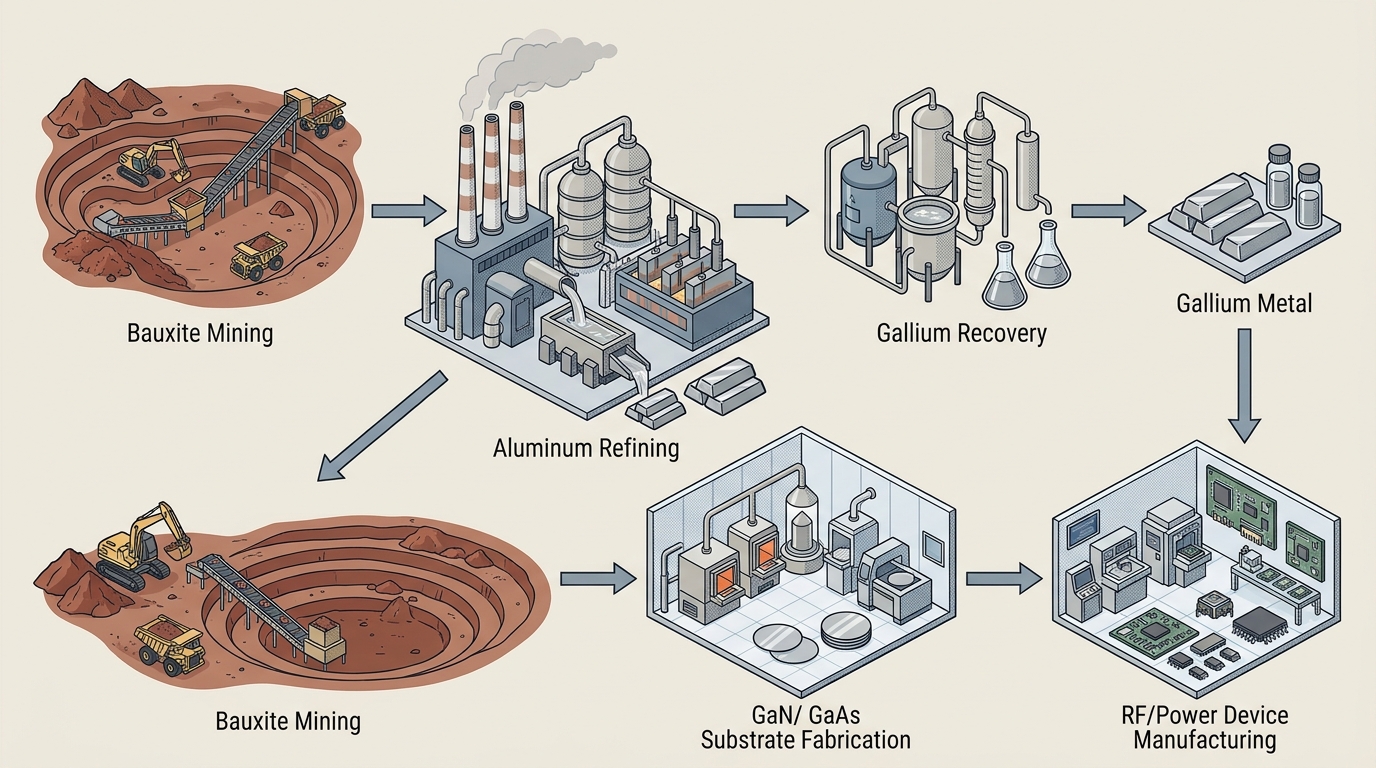
The upstream detail that matters most is origin. Gallium is commonly recovered as a byproduct of aluminum refining, especially from bauxite processing streams, with some linkage to other metallurgical circuits. That means gallium availability is not governed only by gallium demand. It also depends on how much relevant upstream material is processed, whether recovery circuits are active, and whether refiners maintain the extraction steps needed to isolate gallium from larger industrial streams. In practice, this creates a structurally less elastic supply profile than a primary mined metal.
A second recurring discovery point appears during supplier mapping: gallium risk is often hidden inside several conversion stages. Material may move from byproduct recovery into refining, then into high-purity metal, then into wafers, epitaxy, RF devices, or power semiconductors. A downstream manufacturer can therefore appear diversified at the device level while remaining exposed to a concentrated upstream source.
Where gallium matters: end-use criticality and performance dependence
Gallium uses are best understood through the devices it enables rather than through the metal alone. The strongest demand linkage today runs through GaN power electronics and GaAs or GaN RF applications. In 5G base stations, GaN supports power amplifiers and radio-frequency functions where high-frequency performance, thermal robustness, and power density matter. That is why the phrase gallium 5g usually refers to gallium-based RF hardware in telecom infrastructure rather than to the metal in isolation.
In radar AESA systems, gallium compounds are valued because active electronically scanned arrays contain many transmit and receive elements, and performance can improve when each module handles power efficiently under tight thermal constraints. The strategic sensitivity of gallium becomes more visible here because radar electronics combine strict qualification, defense-adjacent compliance, and limited tolerance for redesign.

In EV chargers and other power electronics, GaN is associated with faster switching, smaller passive components, compact form factors, and improved efficiency relative to legacy silicon in some use cases. The point is not that gallium is a battery metal. The point is that gallium nitride can sit inside the charger, converter, or power supply where energy conversion performance matters. LEDs, laser diodes, and other optoelectronic applications remain important as well, reinforcing the fact that gallium demand spans telecom, industrial power, consumer electronics, and defense-related systems.
A practical scope for gallium risk mapping
Operational reviews often become clearer when the chain is divided into distinct nodes rather than treated as a single “metal supply” problem. The first node is byproduct generation inside aluminum-related processing. The second is extraction and purification into gallium metal or higher-purity forms. The third is conversion into semiconductor materials such as GaN and GaAs. The fourth is device manufacturing, including RF components, power semiconductors, LEDs, and specialized modules. The fifth is end-market integration into systems such as telecom base stations, chargers, industrial equipment, and radar.
Each node carries a different risk type. Upstream nodes are exposed to metallurgy, byproduct economics, and jurisdictional concentration. Midstream nodes are exposed to purity control, documentation, and export licensing. Downstream nodes are exposed to qualification cycles, reliability testing, and design lock-in. A useful feature of this mapping is that it separates physical availability from usable availability. Material can exist in the chain while still being unavailable for a given product because purity, form, certification, or licensing do not line up.
Supply concentration and the 2023 China export control regime
The structural issue behind gallium china export exposure is concentration. China has held a dominant position in important parts of the gallium supply chain, including primary production and refining capacity. When a byproduct metal is also concentrated in one jurisdiction, policy risk becomes part of ordinary supply-chain analysis rather than an external headline.
That reality became more formal in 2023 when China introduced an export control regime for gallium and germanium, effective August 1, 2023. The mechanism was licensing, not a universal prohibition. Even so, the operating environment changed in a lasting way. Shipments that once moved as routine industrial trade became subject to a controlled process involving export approvals and end-use related documentation. The practical effect was additional friction around scheduling, compliance review, and shipment certainty.
One consistent lesson from disruption reviews is that licensing regimes affect more than the first exporter. A downstream device maker in North America, Europe, Japan, or Korea can still be exposed if Chinese-origin gallium sits upstream in a non-Chinese conversion chain. The immediate supplier may look geographically diversified, while the actual dependency remains concentrated at the material stage.
Observed failure modes in gallium supply chains
- Byproduct rigidity: gallium output does not always rise in step with gallium demand because production is tied to larger aluminum-related process flows.
- Licensing and document friction: export approvals, end-use declarations, and shipment paperwork can create delays or uncertainty even when material exists.
- Purity and specification mismatch: semiconductor applications are sensitive to trace contamination, and impurity control at the ppm level can affect yield or qualification.
- Single-jurisdiction exposure: multiple suppliers at the device level can still rely on the same upstream country or refining hub.
- Qualification lock-in: once GaN or GaAs devices are designed into 5G base stations, radar modules, or chargers, substitution often becomes a redesign problem rather than a purchasing switch.
- Visibility gaps: procurement systems may classify gallium as an indirect input, leaving hidden exposure inside modules, wafers, or packaged components.
Criteria commonly used to assess resilience
In practice, gallium resilience is usually assessed through a mix of material, process, and compliance criteria. Material criteria include purity grade, form, conversion route, and consistency across batches. Process criteria include whether supply comes from primary byproduct recovery, reclaimed streams, or third-party tolling stages, and whether each stage is traceable. Compliance criteria include export-license exposure, end-user screening, documentation completeness, and the jurisdictions involved at each conversion step.
Another useful criterion is technical criticality. A gallium input used in an LED product line does not carry the same redesign burden as one embedded in a qualified radar AESA transmit module. The same metal can therefore present very different risk profiles depending on the application, even before any geopolitical factor is added.
Substitution and design flexibility
The question “Can gallium be substituted in semiconductors?” rarely has a single answer. In some lower-performance or less space-constrained applications, silicon-based alternatives can be workable if the system tolerates efficiency loss, thermal compromise, or larger footprints. In more demanding RF and power applications, especially those built around gallium nitride, substitution narrows quickly because the material choice is linked to the architecture of the device and the surrounding system.

A recurring discovery in engineering-commercial reviews is that substitution language can be misleading. At the spreadsheet level, it may look as though one semiconductor material can replace another. At the system level, the change can trigger new thermal validation, EMC work, reliability testing, and customer requalification. In that sense, substitution is often a downstream project rather than a near-term supply release valve.
Observed management options and their trade-offs
Several patterns have appeared across companies exposed to gallium risk. One is dual qualification of suppliers or processing steps, especially where upstream origin and downstream device assembly can be separated. Another is the use of reclaimed or recycled gallium streams for applications where purity and traceability align with product requirements. A third pattern is regionalization of selected midstream or downstream steps, intended to reduce the number of cross-border compliance handoffs even when raw material concentration remains. Inventory buffers also appear in some chains, though they mainly address timing friction and do not remove origin concentration or licensing dependency.
Each of these options shifts a different part of the risk rather than eliminating it. Dual qualification can improve continuity but may still leave shared upstream exposure. Reclaimed material can broaden the feed base but introduces its own traceability and specification questions. Regional processing can shorten some trade routes while leaving the core gallium source unchanged. That is why gallium risk analysis often works best as a layered assessment of origin, conversion, compliance, and application lock-in.
Seen through that lens, gallium is not merely a niche metal. It is a small-volume, high-consequence input whose importance comes from the systems it enables and the concentration embedded in its supply chain. The 2023 Chinese export control regime did not create gallium’s strategic relevance, but it made the underlying structure easier to see: byproduct dependence upstream, concentration in key refining stages, and limited flexibility once advanced devices are qualified into critical end markets.