
Strategic metals storage tends to look straightforward until a transfer, audit, customs review, or liquidation event tests the file. In day-to-day operations, the decisive issue is rarely the door thickness of a metal vault. The decisive issue is whether title, specification, location, and release mechanics remain coherent when the material leaves the warehouse or changes hands. That distinction becomes sharper for strategic inventories such as refined precious metals, industrial metals with strategic relevance, and some rare earth storage programs involving oxides, alloys, or intermediate products.
A practical comparison usually rests on three layers: the jurisdictional wrapper, the custody model, and the documentary stack supporting insurance and exit liquidity. Geneva, Singapore, and Delaware each sit in a different part of that map. Geneva is often associated with mature vaulting and trading infrastructure. Singapore is frequently linked to free port storage, transshipment efficiency, and Asia-facing logistics. Delaware is commonly examined through the lens of domestic U.S. custody, warehouse utility, and legal familiarity rather than as a classic free-port jurisdiction.
Key takeaways
- Allocated metal custody and unallocated exposure are different legal and operational animals; the distinction often determines whether an inventory is a direct property interest or a claim on an institution.
- Free zone status can ease customs handling, but free port storage does not by itself solve title ambiguity, assay mismatch, or insurance exclusions.
- For rare earth storage and other specification-sensitive materials, assay certificates, lot numbering, and contamination controls often matter as much as physical security.
- Exit liquidity depends on more than market depth; releasability, load-out mechanics, sanctions screening, and customs classification often control the real timeline.
Operational perimeter: what counts as strategic metals storage
In practice, strategic metals storage covers more than bullion bars. The storage population can include standard precious metals, high-purity industrial metals, concentrates or intermediate products, and niche materials held for working inventory or disruption management. The product form changes the risk profile immediately. A serialized bullion bar usually travels with recognized refinery marks, assay conventions, and familiar release procedures. A mixed rare earth oxide, by contrast, may sit under a different documentary burden, with value linked to TREO content, impurity thresholds expressed in ppm, and packaging conditions that protect lot integrity. Lithium-linked intermediates described in LCE terms raise a similar issue: quantity alone does not settle merchantability if the specification stack is incomplete.
One recurring discovery from storage reviews is that facilities with similar perimeter security can differ sharply in inventory intelligibility. One site may maintain lot-by-lot traceability, chain-of-custody records, and independent audit support. Another may offer strong physical protection but weak reconciliation between warehouse receipt, assay file, and actual releasable stock. For strategic metals storage, that gap often becomes visible only when a counterparty asks for transfer, split lots, or physical withdrawal.
Custody models compared: unallocated, allocated, and segregated
Unallocated exposure
Unallocated storage usually means an account holder has a claim to metal rather than title to identified bars or lots. This structure can support trading fluidity and administrative simplicity, particularly for standardized material. The trade-off is balance-sheet exposure to the storage institution or intermediary. In a stress event, the operational question becomes whether physical deliverability matches the account balance and whether insolvency treatment preserves direct access to metal.
For plain bullion, the market is accustomed to that distinction. For strategic metals, the gap can be wider because non-standard lots are harder to replace quickly and harder to match precisely by specification. A pooled statement showing a metal balance may say little about impurity profile, accepted packaging, or the provenance documents needed for onward transfer.
Allocated metal custody
Allocated metal custody links the holder to identified bars, drums, pallets, cartons, or other lots listed on an inventory schedule. This model usually supports stronger title clarity, cleaner insurance schedules, and more defensible audit trails. It is especially relevant when the stored product is not fully fungible. A named lot with an assay certificate, packing list, and warehouse location is easier to reconcile than a general entitlement to an equivalent weight.
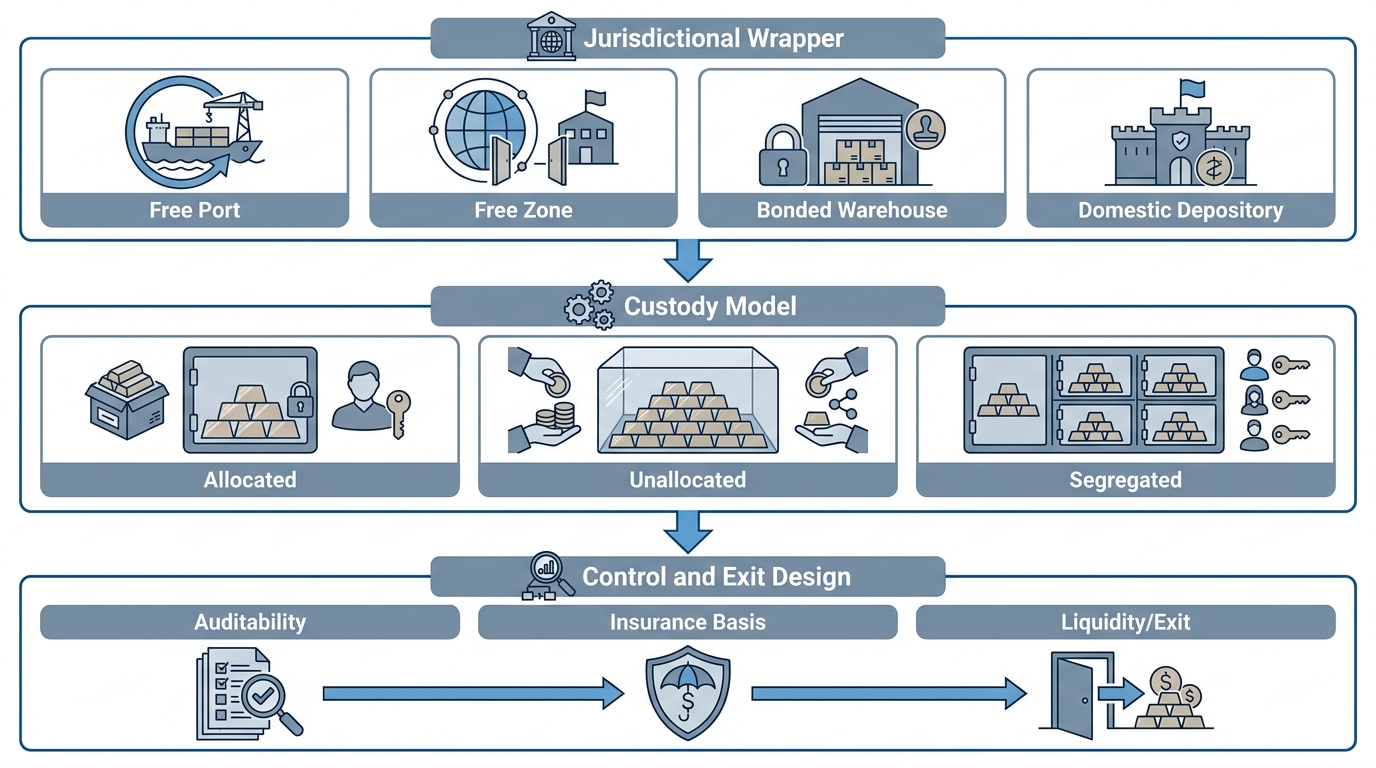
Within strategic metals storage, allocated custody often functions as the baseline format when the material may later move across borders, transfer to another owner, or support a formal stock verification process. The operational benefit is not elegance; it is evidence.
Segregated and hybrid structures
Segregated storage goes one step further by physically separating a holding from other clients’ metal. This format appears more often where contamination risk, handling sensitivity, or client-specific provenance rules are material. Hybrid structures also appear in practice: for example, allocated ownership with shared room storage, or segregated handling only for selected lots. The key variable is how the warehouse agreement describes title, access, substitution rights, and reconciliation procedures.
Provider types and free-zone wrappers
- Private vault operator: usually centered on physical security and controlled access, often strongest for high-value compact materials.
- Institutional depository: commonly adds structured reporting, independent audits, bar or lot schedules, and more formal release workflows.
- Bonded warehouse or free zone facility: often used when customs treatment, deferred import formalities, or re-export flexibility sit at the center of the storage design.
- Industrial warehouse: more common for bulky or process-linked materials, where handling capability matters as much as vault architecture.
Free port storage can be helpful when material is expected to transit internationally, remain under customs control, or move between jurisdictions without immediate domestic import treatment. Even so, free zone status is only one wrapper. A weak custody model inside a free zone still leaves title and release problems unresolved. That is a common misunderstanding in market discussions around strategic metals storage.
Geneva, Singapore, and Delaware: the main comparison points
Geneva is often evaluated as a mature storage and trading node. The attraction generally lies in institutional familiarity, long-standing vault infrastructure, and a legal environment associated with careful documentary standards. Geneva tends to suit holdings where neutrality, audit discipline, and downstream tradability matter more than immediate industrial dispatch.

Singapore is frequently associated with efficient logistics, customs clarity, and a strong role in regional transshipment. For Asia-facing supply chains, free port storage in or around Singapore can fit inventories that may be re-exported, redistributed, or repositioned with relatively little administrative friction. The jurisdiction is often discussed in connection with high-value goods warehousing because the logistics ecosystem is built for speed, compliance, and controlled handling.
Delaware enters the comparison from a different angle. It is not generally viewed as a classic free-port equivalent, but it can be relevant for U.S.-anchored ownership structures, domestic warehousing logic, and legal familiarity around title and secured interests. In practice, Delaware tends to be part of a domestic custody conversation rather than a transshipment or customs-arbitrage conversation.
A useful way to read the three locations is by dominant operating pattern. Geneva often aligns with institutional custody and internationally recognizable documentation. Singapore often aligns with logistics efficiency and regional mobility. Delaware often aligns with domestic legal coherence and U.S. settlement convenience. None of those traits automatically settles the storage decision; product form and exit route usually carry equal weight.
Insurance underwriting basis and the documentary stack
Insurance underwriting for strategic metals storage usually turns on identifiability, handling conditions, and the legal form of ownership. Underwriters tend to view allocated inventories more cleanly because the insured subject can be mapped to specific lots, weights, purity levels, serial numbers where applicable, and known storage locations. A listed bar schedule or lot schedule is easier to underwrite than a general claim on a pool of metal.
For non-standard material, the documentary stack often includes assay certificates, packing lists, warehouse receipts, transport records, and periodic independent audit reports. In rare earth storage, the assay file may carry the real commercial meaning of the lot: TREO basis, elemental distribution, moisture references where relevant, and impurity limits in ppm. In that setting, a warehouse receipt without a matching analytical trail can leave the inventory formally stored but operationally hard to transfer.

- Identity evidence: serial numbers, lot numbers, marks, seal references, and location mapping.
- Specification evidence: assay certificate, refinery or processor origin, purity statement, and impurity profile.
- Condition evidence: packaging status, tamper indicators, and handling restrictions.
- Verification evidence: independent audit record, reconciliation report, and chain-of-custody continuity.
A frequent discovery in underwriting reviews is that “insured” can mean very different things depending on the wording. One policy may respond to physical loss of identified inventory. Another may sit higher up the chain and respond only through institutional liability. That difference matters most when the stored product is hard to replace or difficult to re-assay without delay.
Failure modes observed in practice
- Title ambiguity: account statements exist, but the legal file does not clearly separate customer property from the custodian’s balance sheet.
- Specification drift: the metal in storage remains present by weight, but the assay, contamination profile, or packaging condition no longer supports the expected exit route.
- Customs reclassification: a product stored under one description faces a different treatment when released or exported.
- Insurance mismatch: coverage attaches to the warehouse operation generally, but not clearly to the identified lot or transit leg.
- Release friction: load-out rights, inspection windows, sanctions screening, or administrative approvals slow the move from “owned” to “releasable.”
- Concentration risk: too much inventory, documentary dependence, or political exposure sits in one jurisdiction, one operator, or one route.
Exit liquidity considerations
Exit liquidity in strategic metals storage is often discussed as if it were purely a market question. In operational terms, it is more often a release question. How easily a lot can be sold, transferred, or withdrawn depends on whether title is clean, whether the receiving party accepts the assay basis, whether the jurisdiction supports prompt release, and whether customs or compliance checks reopen the file at the point of movement.
Standardized precious metals generally benefit from broader acceptance across vault networks and trading channels. Strategic and specialty materials can be more path-dependent. A lot stored near an end-use region may have stronger practical liquidity than an equivalent lot in a neutral jurisdiction if the onward route is simpler. Conversely, a neutral storage hub with superior documentation may support faster title transfer even when the physical movement occurs later. That is why metal vault selection and jurisdiction selection are rarely separable from intended exit mechanics.
Viewed through that lens, Geneva, Singapore, and Delaware are less competitors than distinct operating environments. The comparison becomes clearer when each location is matched against product form, legal title architecture, documentation quality, and the realism of the eventual release pathway. For strategic metals storage, those four elements usually explain the resilience of the arrangement far better than a headline description of the warehouse alone.