
Modern enterprises — from automotive and wind-turbine manufacturers to data-centre operators and defence primes — depend on a handful of high-value metals that are increasingly hard to source at specification. When lithium for batteries, copper for power infrastructure, rare earths for electric-motor magnets, or gallium and germanium for electronics become constrained, the effect is rarely a simple price line. It shows up as delayed programmes, requalification cycles, and capital plans reopened under pressure. In practice, critical metals have moved from a technical sidebar to a standing item on the procurement and risk agenda.
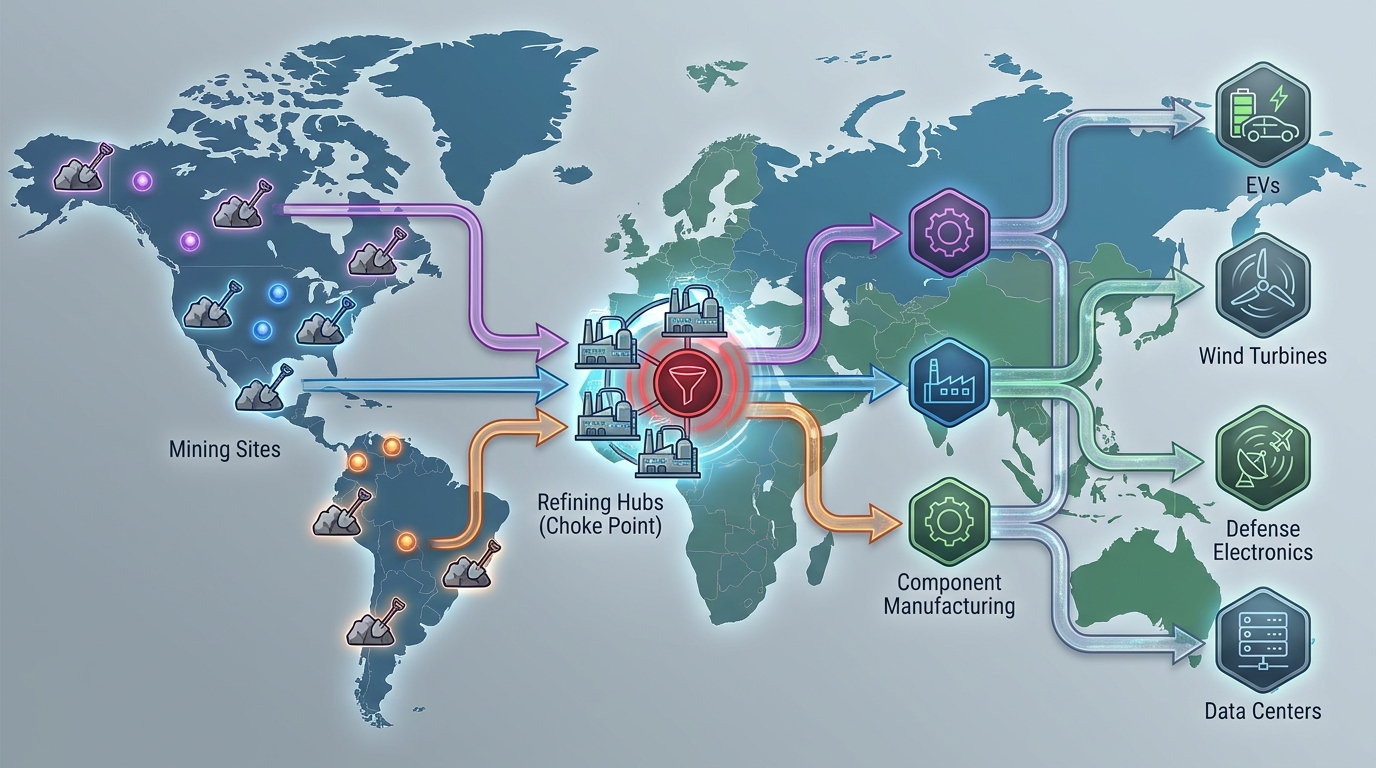
- Exposure is usually created downstream — in separation, refining, alloying, and qualified components — not at the mine, so mine-level diversification alone rarely resolves it.
- Each metal carries a distinct bottleneck and failure mode; a single resilience template applied across all of them tends to hide the real risk.
- Resilience is built through exposure mapping, supplier optionality at the same processing stage, structured contracts, and measured inventory, then tracked with a small set of leading indicators.
- Substitution and recycling matter over time but rarely provide a near-term buffer without performance or qualification penalties.
Defining success: continuity, not commodity exposure
Holding exposure to a trending metal is not a strategy. For an industrial buyer, success is more specific: production continuity with no unplanned stoppages traced to a material shortage, price variance held inside an agreed corridor, and the ability to pivot supplier or process route if a single country or plant stops shipping. A workable objective can be stated plainly — secure access at acceptable cost and acceptable risk, evidenced by mapped exposure, qualified alternatives, and contract coverage across the majority of forecast volume.

The core metals map: aligning inputs to business risk
Critical metals do not behave the same way, and the mitigation that works for one can be irrelevant for another. Aligning each material to its use case and dominant risk is the first practical step.
- Lithium and nickel: EV batteries and grid storage. Risk sits in price volatility and long qualification lead times for new suppliers. Typical response: three-to-five-year supply agreements and co-investment in recycling or precursor capacity.
- Copper: renewable infrastructure, data centres, and charging networks. Risk sits in demand outpacing mine and smelter capacity, plus transport bottlenecks. Typical response: strategic buffer inventory and regional sourcing partnerships.
- Rare earth elements (NdPr, dysprosium, terbium): traction motors, wind generators, and defence electronics. Risk sits in separation and magnet fabrication concentrated in a single country. Typical response: dual-sourcing from emerging refiners and, where the thermal envelope allows, lower heavy-rare-earth magnet designs.
- Gallium and germanium: compound semiconductors, power electronics, optics, and secure communications. Risk sits in export controls and short, by-product-dependent refining chains. Typical response: long-term contracts with release clauses and inventory pooling.
Staged investment: visibility, resilience, optionality
Building resilience is a multi-year commitment best sequenced in horizons rather than attempted at once.
- Short term (0–6 months) — visibility: map exposure by material, supplier tier, and geography, including tier-two and tier-three dependencies, and produce an executive view of revenue at risk per metal.
- Medium term (6–18 months) — commercial resilience: qualify at least two suppliers for each critical material at the relevant processing stage, secure multi-year offtakes, adjust inventory policy, and embed index-linked pricing with caps and floors.
- Long term (18–60 months) — strategic optionality: co-invest in separation, refining, or recycling, or take selective equity or offtake positions where volume and economics support priority allocation.
Context matters for pacing. Magnet demand has been projected to grow at a mid-teens annual rate through the end of the decade, while qualified non-China capacity in several categories remains well under 20% of the total (with named producers such as Lynas supplying a modest single-digit-to-low-double-digit share and others still ramping). That gap is precisely why early qualification and contract structure matter more than spot availability.
A defence-sector view: when burn rate exposes the slowest link
Defence supply chains sharpen the same lesson. Rapid consumption of advanced systems shifts the bottleneck upstream, from finished inventory to specialty metals and qualified components, often outside direct control. Mapping a munition or platform bill of materials makes the exposure concrete: NdFeB magnets in motor and actuator assemblies, tungsten in penetrators and high-temperature contacts, germanium in infrared and guidance optics, gallium in radio-frequency and power electronics, and antimony or titanium in selected munitions and airframe applications. Tungsten and antimony behave like small line items with outsized leverage, because substitution in high-temperature or wear-intensive roles is limited.
The practical workflow is the same as in commercial procurement, applied with tighter documentation: extract the bill of materials, classify each material to supplier tiers with location, qualification status, lead time, and documentation completeness, then score the entries to prioritise remediation. Origin-documentation audits and forward-deployed inventory near production sites reduce lead-time variability, and custody and traceability metrics belong on the same board-level dashboard as readiness.
Measuring progress: a small set of leading indicators
Spend alone is a lagging signal. A short KPI set keeps the programme honest.
- Single-country dependency: share of each critical metal from one jurisdiction, with a target below 50%.
- Contract coverage: share of annual volume under multi-year agreements with defined pricing formulas and force-majeure terms tied to export licensing.
- Inventory days on hand: buffer maintained where logistics or licensing are fragile, commonly a minimum threshold below which review is triggered.
- Price variance versus budget: held within an agreed corridor per material.
- Supply-shock readiness: quantified earnings impact of a modelled 10–20% shortfall, tracked over time.
- ESG and traceability: audit completion and remediation, since a traceability lapse can halt a supply line even when material is available.
- Circularity: recycled or recovered material share.
Governance can turn these into action through simple triggers: a price move beyond planning bands or an export-quota change escalates automatically to procurement and finance rather than waiting for the next review cycle.
Common pitfalls and how to avoid them
- One-size-fits-all thinking: report NdPr, dysprosium, and terbium separately, and treat each metal and value chain on its own bottlenecks.
- Reserve announcements versus usable supply: verify separation, alloy, and magnet capacity plus customer qualification, not just mine output.
- Overreliance on China without scenario testing: build regional alternatives and model quota reductions before they occur.
- Overreliance on recycling: important long term, limited as a near-term buffer.
- ESG oversights: environmental, waste-handling, and community risk can trigger shutdowns before availability does.
- Delayed decisions: once a shortage is visible to everyone, the market has already repriced the risk.
Selecting partners and next steps
The right support reduces operational risk without outsourcing accountability. Useful criteria include end-to-end understanding from ore to component, real-time visibility of pricing, quotas, and demand proxies, proven commercial structuring across offtake and indexed pricing, competence in permitting, radioactive-residue handling, and traceability, and the ability to translate technical complexity into capital-allocation decisions. The clearest red flags are advisors promising a quick exit from China or treating mine ownership as a complete strategy.
A disciplined starting sequence is straightforward: commission a short exposure audit and executive briefing, set board-level targets for contract coverage and country diversification, then design a phased plan that connects procurement, engineering, and finance. Procyon Metals works with buyers and investors on exactly this mapping — exposure, supplier optionality, contract structure, and the indicators that show whether resilience is improving.