Samarium-Cobalt Magnets and the High-Temperature Selection Problem
Samarium cobalt magnets sit in a part of the permanent-magnet landscape that is often discussed far less than neodymium-iron-boron, yet in several defense-adjacent and aerospace systems they are the material that closes the engineering problem when NdFeB does not. That distinction matters for family offices, strategic metals analysts, private wealth advisors, and defense supply-chain observers because the decision is rarely about the strongest magnet in a catalog. It is about magnetic stability under heat, corrosion, thermal cycling, and long qualification windows.
The essential point is straightforward. SmCo is not a general-purpose replacement for NdFeB, and it is not merely “NdFeB for hotter environments.” It is a different material bargain with a different manufacturing route, a different failure profile, and a different upstream risk map. In engineering terms, SmCo gives up part of the maximum energy product that makes NdFeB so valuable in compact motors and consumer electronics, but it gains operating-temperature headroom, corrosion resistance, and more predictable coercivity across hostile thermal envelopes. In strategic-metals terms, that means samarium cobalt magnets belong to a narrower market by tonnage, yet one with unusually high consequence per kilogram.
That is where the recent focus has sharpened. The latest development in this segment is not a headline chemistry breakthrough. It is the tightening relationship between thermal qualification, cobalt traceability, non-Chinese rare-earth processing ambitions, and defense-program continuity. High-temperature magnet exposure is increasingly understood less as a simple materials story and more as a continuity-of-operations question across mining, separation, alloy production, sintering, machining, and end-use certification.
What SmCo actually is, and why the crystal structure matters
Commercial samarium cobalt magnets are usually discussed in two families: SmCo5, often called the 1:5 series, and Sm2Co17, commonly called the 2:17 series. The second family often includes additional alloying elements such as iron, copper, and zirconium to tune magnetic and thermal behavior. This is not chemistry trivia. The alloy family influences coercivity, remanence, maximum operating temperature, and the complexity of processing. In practice, 2:17 grades generally push the usable magnetic performance higher, while preserving the thermal stability that defines the SmCo category.
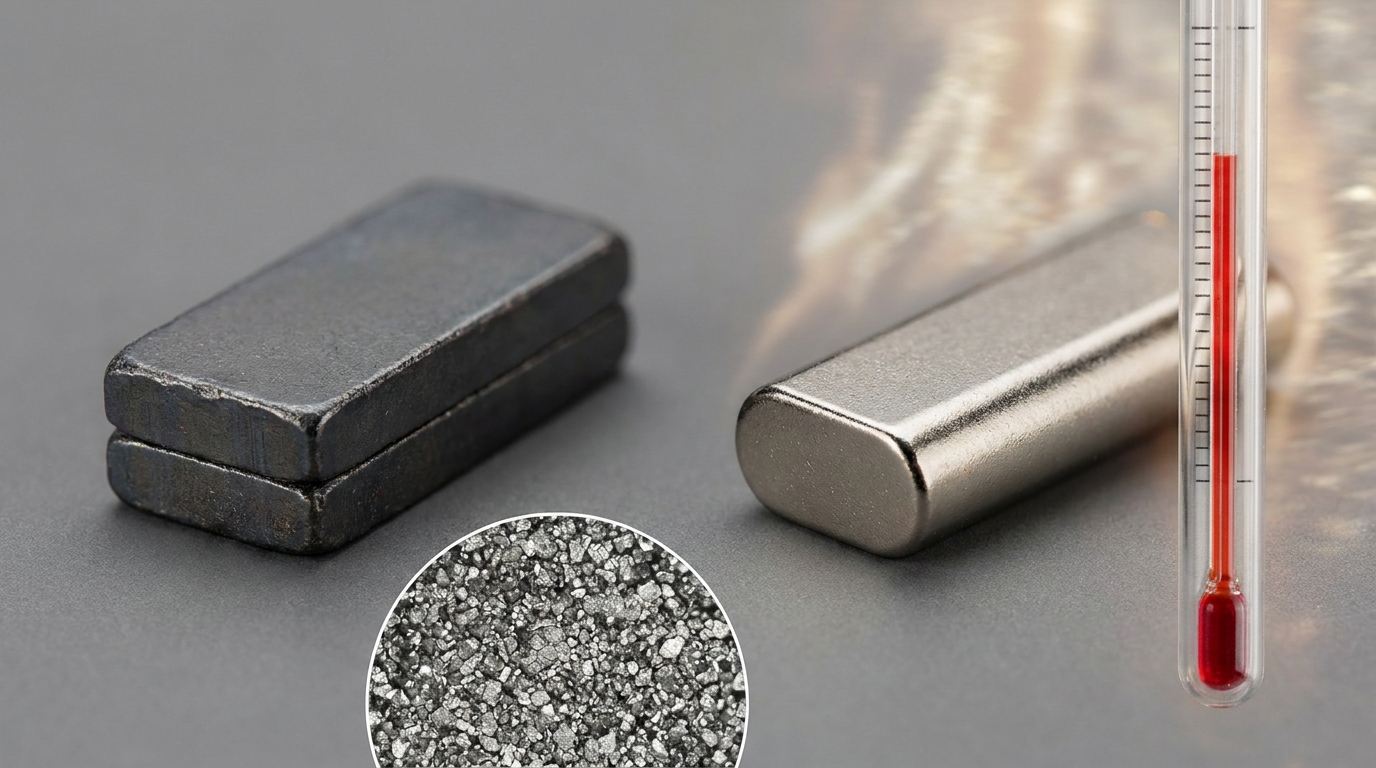
Published design literature and manufacturer datasheets commonly place standard NdFeB continuous service near roughly 80°C, with higher-temperature grades extending toward about 150°C before demagnetization risk and remanence loss become more difficult to manage. SmCo grades are commonly used across approximately 150°C to 300°C, and specialty formulations are cited in the research brief as reaching continuous operation up to about 550°C. That difference explains why samarium cobalt magnets appear in radar assemblies, actuators, sensors, down-hole tools, and aerospace electronics where thermal transients are part of normal service rather than an exception.
Another less appreciated differentiator sits at the cold end of the spectrum. SmCo retains magnetic functionality at cryogenic temperatures approaching absolute zero, which is why the material shows up in scientific instrumentation and other low-temperature assemblies where NdFeB becomes a less reliable choice. In other words, SmCo is unusual because it spans both heat and cold. That dual-envelope capability is precisely why the material keeps resurfacing in technical programs that cannot tolerate magnetic drift.
The trade-off is real. NdFeB usually wins on raw magnetic strength per unit volume. The research brief cites SmCo at roughly 25-28 MGOe BHmax, materially below higher-end NdFeB grades. That is why SmCo does not displace NdFeB in every motor, drive, speaker, or traction platform. The system designer choosing SmCo is not buying maximum flux density. The system designer is buying stability when the thermal budget, corrosion burden, and demagnetization margin dominate the specification.
That sentence is worth stating plainly because it captures the entire category: SmCo is not NdFeB with a heat shield attached. It is a different physical compromise, and the applications that justify it tend to be the ones where failure is operationally expensive, qualification is slow, and replacement is not casual.
How samarium cobalt magnets are made, and why the process shapes the risk
SmCo production is a powder-metallurgy story. The typical route begins with alloy melting, usually in vacuum or controlled atmosphere, followed by coarse crushing, fine milling, magnetic alignment, compacting, sintering, heat treatment, precision grinding, and final magnetization. The equipment list is familiar to magnet specialists: vacuum induction melting systems, inert-atmosphere milling lines, presses or isostatic compaction systems, sintering furnaces, aging furnaces, diamond grinding equipment, and high-field magnetizers. Each stage matters because magnetic performance is tied tightly to grain orientation, phase control, oxygen management, and dimensional tolerance.
Several operational implications fall out of that route. First, SmCo is brittle. The material can chip or crack during machining and assembly, which raises scrap risk and handling requirements. Second, fine samarium- and cobalt-bearing powders demand oxygen control and disciplined dust management. Third, final dimensions are usually achieved by grinding rather than easy post-processing, which increases manufacturing sensitivity compared with softer engineered materials. Plant-level energy consumption in kWh per tonne was not specified in the provided materials, but the major drivers are clear enough: vacuum melting, controlled milling, high-temperature sintering, and precision grinding all impose meaningful utility and maintenance loads.
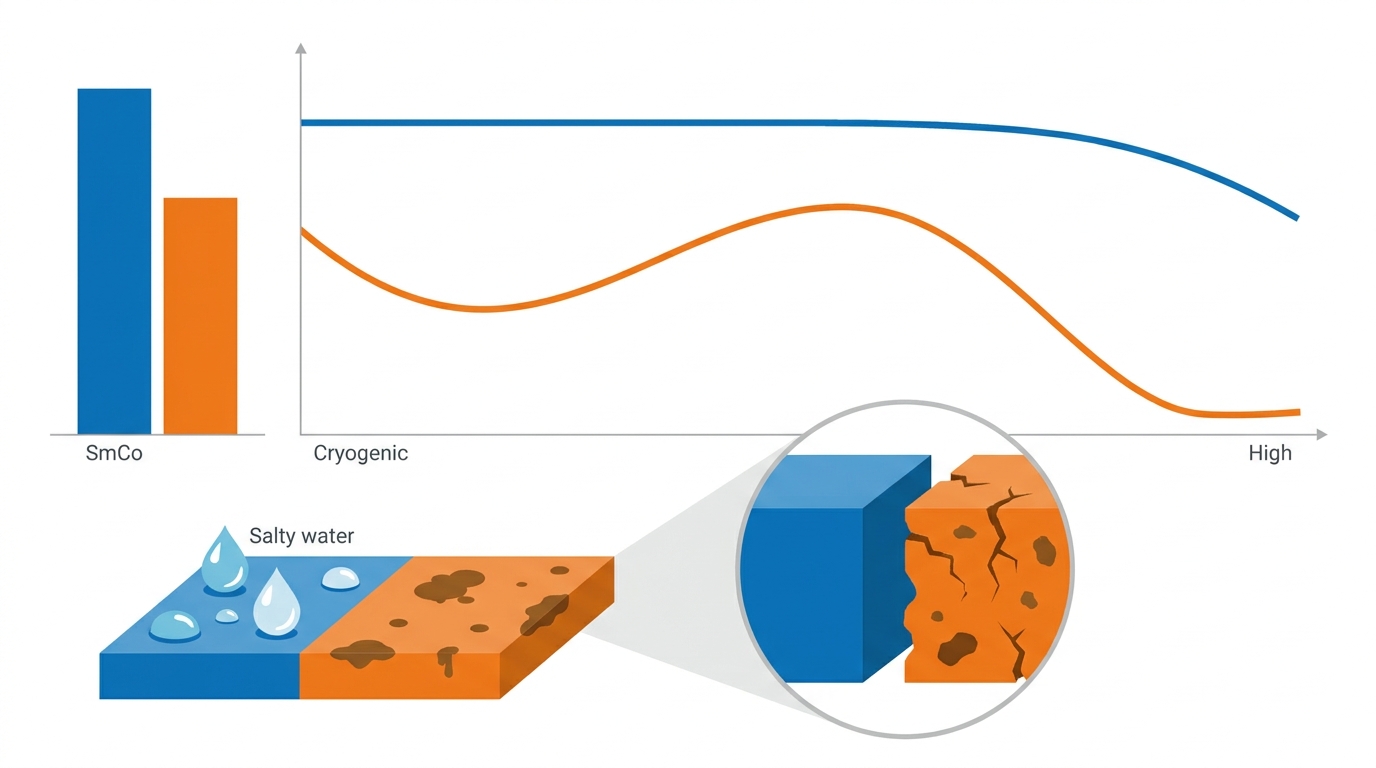
Corrosion behavior changes the downstream burden as well. NdFeB often requires nickel, epoxy, or other protective coatings because iron-rich compositions are vulnerable to oxidation, particularly in humid or marine conditions. SmCo’s lower iron content gives it a built-in corrosion advantage, which simplifies some assemblies and improves durability in salt-laden or chemically aggressive environments. That does not mean the material is effortless. It means the engineering effort shifts from coating preservation toward fracture management, tolerance control, and thermal qualification.
One of the more important execution insights emerges here. When a magnet program moves from catalog selection to production reality, the dominant issue is often no longer only the alloy. It becomes the interaction between alloy quality, machining yield, adhesive performance, magnetic circuit design, and thermal derating. That is why samarium cobalt magnets look deceptively simple on a comparison chart and substantially more complex once production engineers, qualification teams, and compliance officers enter the room.
SmCo versus NdFeB without the usual oversimplification
Comparing SmCo and NdFeB in plain English is useful, but oversimplification distorts the actual engineering decision. NdFeB usually offers stronger magnetic performance for a given size, which is decisive in compact motors, many consumer electronics, and applications where volume efficiency is the first-order variable. SmCo, by contrast, is often chosen where the field must remain stable despite elevated temperature, corrosive exposure, or severe thermal cycling. The correct comparison is therefore not “better” versus “worse.” It is “which constraint dominates the system.”
- Raw magnetic strength: NdFeB generally leads on BHmax and compactness.
- Operating temperature: SmCo generally leads, particularly once continuous service moves well beyond standard NdFeB limits.
- Corrosion resistance: SmCo generally leads because of lower iron content and reduced coating dependence.
- Cryogenic behavior: SmCo is the more reliable choice in very low-temperature environments.
- Mechanical robustness: neither material is forgiving, but SmCo’s brittleness is a recurring manufacturing and assembly issue.
- Cost and upstream risk: NdFeB is tied closely to neodymium and often dysprosium or terbium in high-temperature grades; SmCo is tied to samarium and cobalt, with cobalt often acting as the sharper supply-chain pressure point.
Heavy rare earths complicate the comparison further. High-temperature NdFeB grades often rely on dysprosium or terbium additions to hold coercivity at elevated temperature. That can extend service temperature, but it also raises cost, changes magnetic performance, and introduces a different rare-earth dependency profile. SmCo therefore does not sit opposite standard NdFeB alone; it also sits opposite a subset of enhanced NdFeB grades that solve part of the temperature problem while importing heavy-rare-earth exposure. This is precisely why the phrase “substitute” often obscures more than it clarifies.
There is another practical difference that engineers rarely ignore: magnetic predictability over time. In defense and aerospace assemblies, a slight drift in magnetic behavior can cascade into sensor noise, actuator deviation, or radar-component instability. In these systems, the magnet is often small in mass and enormous in consequence. That is why SmCo remains relevant even though the broader magnet market is dominated by NdFeB volumes.
Where samarium cobalt magnets actually earn their place
The research brief correctly anchors the most important use cases. Aircraft and spacecraft actuators, high-reliability sensors, missile components, radar hardware, and traveling-wave tube magnet assemblies all value stable magnetic properties across steep thermal excursions. In these systems, electromagnetic stability is not cosmetic. It influences guidance fidelity, signal integrity, control response, and service-life confidence. That is why SmCo shows up repeatedly in defense rare earth magnets discussions even though it receives far less public attention than NdFeB.
Industrial service offers a parallel case. Down-hole oil and gas tools operate in hot, corrosive, high-pressure environments where standard NdFeB can become a liability. Marine motors and generators face humidity, salt, and long maintenance intervals. Certain traction and turbo-machinery components encounter sustained thermal loading that turns high-temperature magnet selection into a reliability issue rather than a procurement detail. SmCo’s combination of heat tolerance and corrosion resistance often becomes the deciding factor in these regimes.
Scientific and cryogenic applications are even clearer. Benchtop NMR systems, particle-accelerator subsystems, and cryogenic sensors require magnets that do not become erratic when the operating environment is deeply cold. SmCo is one of the few permanent-magnet classes that can bridge that demand while still supporting practical field strengths. This often surprises generalist observers because the public conversation around rare-earth magnets is usually dominated by electric vehicles and wind turbines. SmCo’s core territories are different: smaller volume, tighter qualification, harsher service, and less tolerance for field instability.
That leads to a sharp but accurate observation. Samarium cobalt magnets are not everywhere because they do not need to be. They appear where system designers run out of tolerance for heat, corrosion, and magnetic drift.
Where SmCo does not replace NdFeB
The temptation to frame SmCo as the next broad magnet alternative misses the economics and the engineering. NdFeB remains the dominant choice in many electric motors, electronics, audio components, and energy applications because it delivers more magnetic strength per unit volume and because many of those systems can be designed around its thermal limits. If the equipment can be cooled, coated, shielded, or derated economically, the case for SmCo often weakens quickly. The same is true when the application is highly cost-sensitive and magnetic strength drives miniaturization.
SmCo also brings manufacturing penalties. The material is expensive to process, brittle in handling, and less forgiving during machining and assembly. Change one thing in the discussion-raise the temperature, add corrosion, extend service life, increase qualification cost, tighten magnetic stability requirements-and SmCo begins to make more sense. Remove those constraints, and NdFeB usually retakes the field. This is why the most serious expert perspective in this category is also the least dramatic: material selection in permanent magnets is mostly an exercise in constraint ranking.
Supply-chain architecture: samarium and cobalt do not carry the same risk
SmCo magnets depend on two strategic inputs that behave very differently upstream. Samarium is a light rare earth, usually recovered as a co-product within broader rare-earth mining and separation systems rather than pursued as an isolated mining target. The research brief cites global samarium production in the range of roughly 2,000 to 3,000 metric tonnes annually, far below neodymium output, and notes the heavy concentration of rare-earth processing in China. That matters because samarium availability is not only a geological issue. It is a separation-and-refining issue, and separation capacity is geographically concentrated.
Cobalt is the sharper independent constraint. The research brief notes that the Democratic Republic of Congo accounts for roughly 70% of global cobalt supply, with additional output from jurisdictions such as Zambia, Russia, Australia, and Canada, while significant refining capacity remains concentrated in China. Unlike samarium, cobalt is not primarily pulled by permanent magnets. It has its own large competing demand centers, especially batteries. That means the cost, traceability, and availability of cobalt are shaped by a much broader industrial contest than the SmCo magnet sector alone.
The result is a two-layer supply-chain problem. Samarium exposure is tied closely to rare-earth separation concentration and export-policy sensitivity. Cobalt exposure is tied to mine geography, refining bottlenecks, battery-market competition, and responsible-sourcing scrutiny. A program can therefore face adequate samarium chemistry but strained cobalt procurement, or secure cobalt units but limited access to qualified samarium-bearing magnet feedstock. The bottleneck is rarely one mine or one refinery in isolation. The bottleneck is the intersection of samarium separation, cobalt traceability, and long qualification cycles.
That intersection is where industrial resilience becomes the relevant frame for capital allocators and strategic-metals observers. SmCo exposure is easy to misunderstand if viewed only through commodity tonnage. The more informative lens is qualification lock-in. Once a defense or aerospace assembly is validated around a specific magnet chemistry, dimensional tolerance, coercivity class, and thermal behavior, substitution is slow and documentation-heavy. A temporary upstream dislocation can therefore have consequences out of proportion to the physical mass of material involved.
Implementation, maintenance, and compliance constraints
Operational reality begins with qualification. Aerospace and defense platforms do not absorb magnet substitutions casually because the magnet is part of a broader magnetic circuit, thermal model, and lifetime-performance envelope. Coercivity at temperature, irreversible flux loss, vibration response, corrosion behavior, outgassing characteristics for space use, adhesive compatibility, and machining-induced edge damage can all become qualification items. The technical data package is therefore as important as the alloy label on a procurement sheet.
Maintenance considerations are similarly specific. SmCo’s corrosion resistance can reduce coating-management burdens, but brittle fracture risk remains a practical issue during assembly, rework, and service. Fixtures, handling protocols, and magnet placement must account for chipping and crack initiation. In motors and actuators, thermal cycling can also interact with adhesives, sleeves, or retaining structures even when the magnet itself remains magnetically stable. A high-temperature magnet that survives thermally but fails mechanically is still a failed design.
Compliance adds another layer. Cobalt sourcing draws responsible-minerals scrutiny, while rare-earth separation can draw trade-policy and export-control attention. Defense and aerospace buyers also tend to require stronger lot traceability, tighter materials documentation, and more rigorous change control than commercial programs. None of this is abstract. A magnet supplier may have acceptable chemistry but inadequate documentation discipline for regulated end markets. That gap can be just as disruptive as a raw-material shortage.

One practical conclusion follows. In SmCo programs, manufacturing competence and documentation discipline are part of the material specification, not an administrative afterthought.
What high-temperature magnet exposure means for family offices and strategic-metals observers
For family offices and strategic-metals observers, the relevant takeaway is not a broad-brush narrative about demand growth alone. High-temperature magnet exposure is a specific form of industrial exposure. It sits where small material volumes can support high-value systems, where program qualification slows substitution, and where two upstream inputs-samarium and cobalt—belong to different geopolitical and processing risk structures. That makes the category analytically rich even when its tonnage is modest relative to NdFeB-heavy markets.
The most useful lens is often value-chain segmentation. Upstream risk lives in rare-earth mining, separation chemistry, cobalt mine output, and refining concentration. Midstream risk lives in alloying, powder control, sintering, precision machining, and scrap recovery. Downstream risk lives in certification, thermal performance, long-life reliability, and the inability to requalify a mission-critical assembly quickly. When these layers are mapped together, SmCo stops looking like a niche curiosity and starts looking like a specialized materials system with unusually high continuity sensitivity.
That is also why simplified comparisons to NdFeB can mislead capital allocators. NdFeB and SmCo do compete in some design spaces, but SmCo’s most defensible positions are often the ones that cannot be arbitraged away by a cheaper magnet unless the entire system architecture changes. In plain terms, some end markets buy SmCo not because it is elegant, but because the alternative introduces an unacceptable thermal or reliability penalty.
Observed scenarios, trade-offs, and limiting conditions
- SmCo tends to be selected when continuous temperature is elevated, thermal cycling is severe, corrosion burden is persistent, cryogenic operation is relevant, or magnetic drift has outsized system consequences.
- NdFeB tends to remain dominant when compactness, peak magnetic strength, and lower system cost matter more than extreme thermal stability.
- High-temperature NdFeB grades can narrow the gap, but often at the price of heavier rare-earth dependence and more complicated cost-performance trade-offs.
- Manufacturing limits for SmCo often appear in brittleness, machining yield, assembly damage, and supplier qualification depth rather than in chemistry alone.
- Supply-chain limits often arise from the combined effect of rare-earth separation concentration, cobalt sourcing scrutiny, and long validation cycles in aerospace and defense programs.
Those conditions define the success and failure boundary more accurately than headline demand narratives do. The strongest applications for samarium cobalt magnets are the ones where the thermal and environmental envelope is not negotiable. The weakest are the ones where a clever engineer can redesign cooling, add coatings, accept larger dimensions, or switch to enhanced NdFeB without destabilizing the program. That is the real shape of the decision.
Note on Procyon methodology Procyon crosses trade-text monitoring, including MOFCOM and related export-control or industrial-policy notices where relevant, with supply concentration data cited in the brief and the operating specifications of end-use systems. The analysis then tests material stories against actual engineering constraints such as temperature envelope, coercivity retention, corrosion burden, qualification difficulty, and service-life requirements.
Conclusion
Samarium cobalt magnets remain strategically important because they solve a narrow but critical class of magnetic problems that NdFeB does not solve cleanly. Their relevance comes from thermal stability, corrosion resistance, and magnetic predictability under harsh service conditions, balanced against weaker raw magnetic strength, brittle mechanics, and a supply chain that depends on both samarium separation and cobalt traceability. In practical terms, SmCo belongs less to the world of commodity magnet substitution than to the world of qualification-sensitive systems where a small component can carry a disproportionate operational burden. Procyon Metals maintains active monitoring of the weak signals in magnet metals, export policy, qualification behavior, and end-use specifications that will define the next phase.
For discussion of magnet metals exposure across samarium, cobalt, NdFeB, and specialized high-temperature magnet markets, Procyon Metals remains available for confidential briefing.