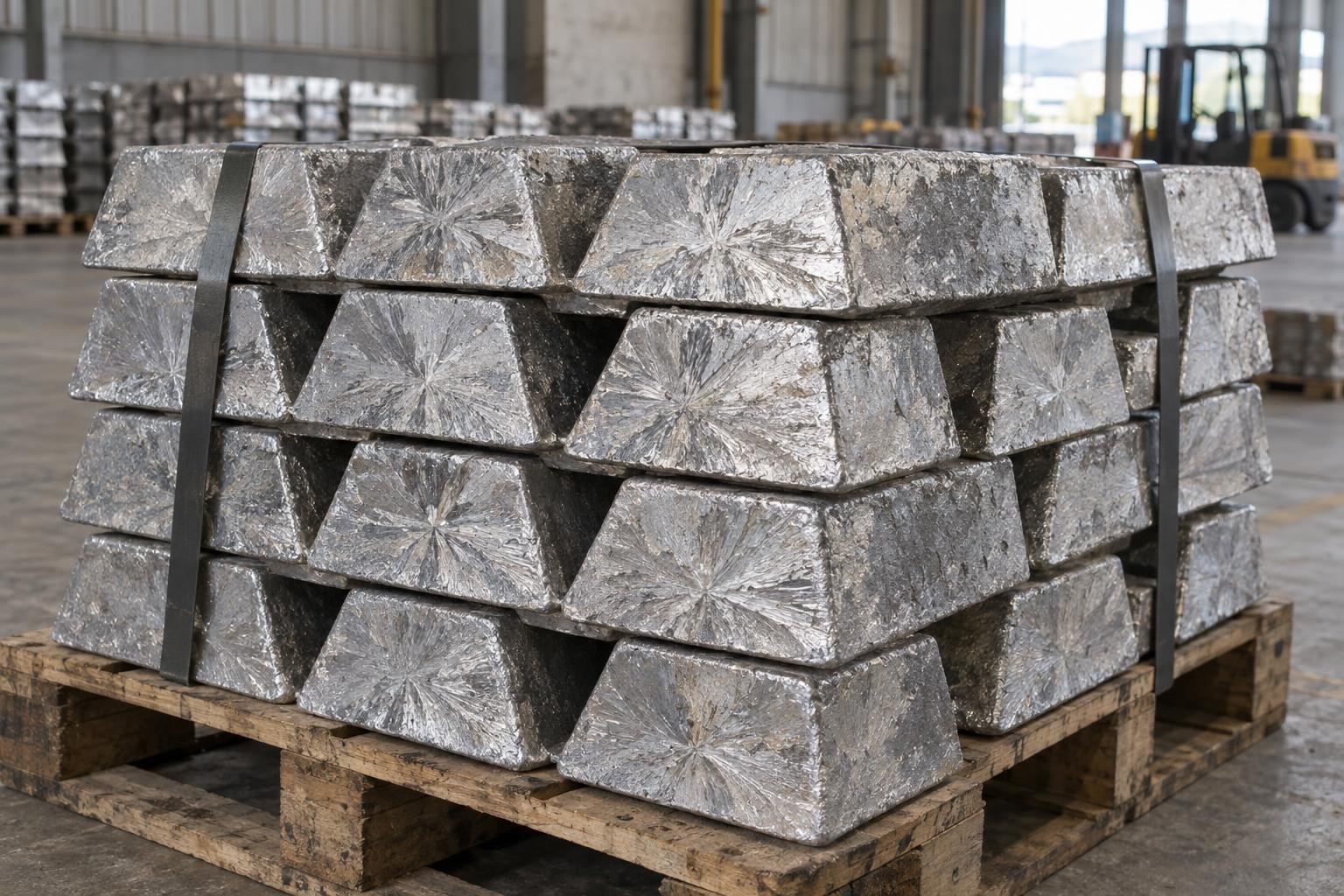
Commercial antimony ingots are offered around 99.5%–99.65% Sb, with supplier specifications also listing higher grades. Headline purity alone does not establish industrial acceptance or legal ownership. Resale depends on lot-specific impurity data, traceable custody and provenance, and a buyer able to accept the material in its storage jurisdiction.
An antimony ingot stored under one lot number and assayed under another leaves a prospective buyer without a direct link between the certificate and the deliverable metal. Even a detailed assay cannot resolve that break in identification. Assessing physical ownership and resale feasibility therefore involves connecting the material, its specification, its owner and the conditions under which it can be released and transferred.
Key points
- Grade is more than total antimony content. A 99.65% Sb certificate may still omit impurity limits relevant to the intended industrial buyer.
- Antimony trioxide is a different product. Its chemical assay, physical properties, handling requirements and buyer base cannot be substituted for those of an antimony-metal ingot.
- Custody and ownership require separate evidence. A warehouse inventory statement records possession; the contract and title documents determine the holder’s rights to the identified material.
- Supply restrictions do not guarantee resale access. Origin, location, export authorization and buyer qualification can restrict a transaction even when published antimony prices have risen.
What an antimony ingot grade actually establishes
Commercial antimony ingots are offered in grades around 99.5% to 99.65% Sb, where Sb denotes elemental antimony. Supplier specifications also list Sb99.85, Sb99.90 and, from some suppliers, Sb99.95. These designations express minimum antimony content by mass; the accompanying impurity limits define the rest of the specification. They do not establish a universal retail or resale standard.
The distinction matters because two lots with the same stated Sb percentage can have different impurity profiles. A buyer’s specification may impose separate ceilings for arsenic, lead, iron, copper, selenium, bismuth and sulfur. A certificate reporting only total Sb leaves those acceptance questions unanswered. A higher headline purity does not resolve an omitted impurity result.
Commercial formats include ingots of approximately 25 kg, often palletized at about 1,000 kg, although dimensions, packaging and parcel sizes vary by supplier and contract. Neither a familiar grade designation nor a conventional ingot size establishes acceptance by a particular industrial purchaser.
A usable certificate of analysis identifies the producer or issuing laboratory, certificate number, batch or heat number, sample date, sampling method, analytical method and reported results. Its lot identifier connects those results to the packing list, package markings and warehouse inventory. A producer’s generic product data sheet describes a specification; a delivered-lot assay reports measurements on identified material. The two documents serve different purposes.
For a physical-antimony holding, “investment grade” is therefore insufficient language. The risk and verification prerequisites concern which industrial specification the ingot meets, which evidence supports that specification and which buyer accepts the producer, form and impurity profile.
Metal, trioxide, powder and concentrate are different deliverables
| Product form | Evidence describing the material | Resale constraint |
|---|---|---|
| Cast antimony-metal ingot | Elemental Sb assay, individual impurity results, casting form, net weight and lot identification | Acceptance depends on the producer, composition, parcel size, origin and delivery location. |
| Antimony trioxide, Sb₂O₃ | Sb₂O₃ assay, particle-size specification, whiteness, impurity profile and packaging records | It is a chemical product, not metal; sale into a metal-ingot market involves conversion and separate acceptance terms. |
| Antimony-metal powder | Elemental assay, particle-size information, packaging specification and applicable safety documentation | Powder handling and buyer qualification differ from those for cast ingots. |
| Ore or concentrate | Contained Sb, moisture, impurity and penalty-element assays, and processor acceptance terms | Payable content depends on treatment, refining and recovery terms; feedstock is not equivalent to refined metal. |
Antimony trioxide is a white chemical powder used principally as a flame-retardant synergist—an additive that enhances the performance of a flame-retardant system. Its formula, Sb₂O₃, includes oxygen. Pure Sb₂O₃ contains approximately 83.54% elemental antimony by mass. That percentage describes theoretical chemical composition only: it is neither a processing yield nor a resale-equivalent quantity of metallic antimony. A tonne of oxide is not commercially interchangeable with a tonne of 99.65%-pure antimony metal.
Recovering metal from trioxide involves reduction, energy, processing equipment, environmental controls and a qualified processor. Product impurities, moisture, processing losses and commercial deductions separate theoretical contained antimony from payable recovered metal. Likewise, a high Sb₂O₃ assay does not establish suitability for a chemical customer if particle size, whiteness or contamination falls outside its specification.
Product descriptions in trade statistics also warrant care. The US Geological Survey’s antimony summary groups unwrought metal and powder together in some import data. That category cannot establish that a particular shipment consisted of cast ingots, nor can its average trade value substitute for an ingot resale quotation.
Industrial demand does not create a single buyer pool
Eurostat identifies flame-retardant uses of antimony trioxide and lead-antimony applications in vehicle, backup-power and industrial batteries. The European Commission’s Joint Research Centre also identifies defence uses, including ammunition and armour-piercing rounds, alongside applications in night-vision equipment, infrared sensors and precision optics.
These uses lead to different purchasing specifications. A flame-retardant producer evaluating trioxide is not evaluating the same deliverable as a lead-alloy manufacturer buying elemental metal. Defence-related demand is not evidence that an unidentified ingot qualifies for a particular manufacturing process or procurement chain. Producer approval, assay requirements, packaging and provenance remain buyer-specific.
The useful evidence of an exit market is therefore a buyer’s acceptance of the proposed material, not a list of sectors that consume antimony. A documented industrial specification and a dated bid for the matching lot are materially different from a seller’s statement that the metal has strategic uses.
What proves ownership of the stored antimony
A physical-antimony contract distinguishes ownership of identified ingots or lots from an interest in fungible inventory or a contractual repayment claim. The word “allocated” does not identify the property or establish the holder’s rights by itself. Serial numbers support identification where they exist; otherwise, lot numbers, package identifiers, weights and controlled warehouse records provide the connection.
- Acquisition and title: the purchase contract, invoice, payment record and title or warehouse document identify the parties, material and ownership arrangement.
- Material identity: the certificate of analysis, packing list, net and gross weights, package marks and delivery confirmation connect to the same lot.
- Custody rights: the storage agreement identifies the owner and defines segregation arrangements, inspection rights, release conditions, fees and responsibility for discrepancies.
- Transfer history: transport records and subsequent warehouse entries connect the purchased lot to the material currently held.
These records support different propositions. A warehouse receipt showing weight does not establish grade without a link to the appropriate assay; an assay does not establish ownership, absence of liens or export authorization. For pooled inventory, the governing documents determine whether the holder has an undivided property interest or only a claim against the operator. The legal treatment depends on the arrangement and jurisdiction, rather than on a universal resale-document checklist.
Material inspection addresses a separate question. Weighing, visual inspection, package and seal checks, and document reconciliation can identify discrepancies between the records and the stored goods. Portable X-ray fluorescence, or XRF, screens for composition inconsistencies but does not establish complete trace-element compliance, internal homogeneity, origin or title. Laboratory confirmation addresses impurity limits or disputed results beyond the screening method’s scope.
Storage preserves the lot and its documentation
For cast antimony ingots, the custody specification centers on dry, secure storage, protection from contamination and controlled access. Physical and administrative segregation preserve distinctions between lots with different producers, origins or assays. An inventory balance that combines those lots may preserve total weight while losing the evidence needed to resell a particular parcel.
Packaging and records perform a joint function. Legible marks, intact seals and controlled repacking records preserve the link to the assay and provenance file. Broken seals, replacement labels or unexplained changes in package count can trigger fresh inspection or sampling under a buyer’s acceptance terms. Photographs support identification but do not replace inventory reconciliation or release controls.
Antimony trioxide and powdered products involve a different handling assessment. Sealed packaging, dust management, exposure controls and the applicable safety data sheet, or SDS, form the basis for storage and workplace handling. Transport classification, hazard labels and emergency-response information address the applicable product and route. A warehouse equipped for cast metal is not, for that reason alone, qualified to handle chemical powders.
Insurance review concerns the actual policy wording, not merely the existence of a certificate. Relevant loss events include theft, fire, water damage, contamination, substitution and misdelivery. Coverage limits, exclusions and valuation terms determine the response to each event. Inventory reconciliation, access logs, controlled release authorization and incident reporting demonstrate custody controls; an insurance certificate does not.
Supply concentration changes the provenance review
Antimony supply concentration is not a single statistic. The USGS 2025 summary attributes approximately 63% of US antimony metal and oxide import sources during 2020–2023 to China. Within the separate categories, China accounted for 76% of oxide sources but 24% of unwrought metal and powder sources. These figures describe US import sourcing, not China’s share of global mine production.
The European Parliament records China’s announcement of antimony export controls on 14 August 2024 and their implementation on 15 September 2024. The USGS 2025 summary records China’s December 2024 ban on antimony exports to the United States. These dated measures explain why an origin certificate alone cannot answer whether a proposed shipment is legally deliverable. The applicable rules depend on the product, destination, parties and end use at the time of transfer; the historical measures do not substitute for that transaction-specific assessment.
Eurostat’s 2025 EU trade figures show a changed sourcing pattern: Tajikistan supplied 52% of EU antimony imports, while China supplied 3%, down from 16% in 2024. Those import-source figures do not, by themselves, identify the mine or refinery behind an individual lot.
A provenance assessment distinguishes mine origin, refinery location and export origin. A shipment dispatched from a third country does not resolve where the antimony was mined or processed. Relevant evidence includes the producer or refinery identity where disclosed, origin documentation, chain-of-custody records, customs declarations and export licences where applicable. A missing mine-origin record remains a provenance gap even if the refinery and dispatch country are documented.
Compliance review also covers the seller, refiner, warehouse, carrier, beneficial owners, transit route and intended end use. Storage location is part of the resale assessment: a prospective buyer may be unable to accept material whose release, customs status or export documentation cannot be resolved. Physical possession does not remove those constraints.
How a resale bid differs from an antimony price indication
Eurostat reports that EU antimony import prices rose 167% between 2024 and 2025, while export prices rose 180%. These are changes in trade-flow prices, not executable quotations for a privately held 99.65% Sb ingot. They do not establish a retail bid-ask spread, a fabrication-premium recovery or the proceeds available for a particular parcel.
A meaningful price comparison identifies the product form, grade, impurity limits, net weight, lot size, location, currency, quotation date and delivery term. Metal, oxide, powder, alloy and concentrate cannot be compared solely by their gross shipment weight or an undifferentiated “antimony” price.
Resale terms also determine the payable quantity and deductions. Depending on the product and contract, these can include sampling, treatment, refining, transport, compliance, financing and inventory-risk costs. Concentrates introduce additional questions about moisture, recovery, arsenic and other penalty elements. For ingots, acceptance of final weight and grade can be conditional on the buyer’s own sampling and laboratory results.
- Technical acceptance: the bid identifies the accepted form, producer, assay limits and packaging, together with any condition for fresh sampling.
- Commercial settlement: the terms state how payable weight and grade are determined, which deductions apply and how assay disagreements are resolved.
- Delivery feasibility: the proposed route accounts for warehouse release, customs status, transport documentation and any applicable licences.
- Counterparty obligation: a repurchase undertaking identifies the legal buyer, acceptance conditions and payment obligation rather than merely promising “liquidity.”
Small bars or decorative formats can include fabrication premiums without demonstrating industrial resale acceptance. An assay does not establish that a buyer will pay for those premiums. Similarly, a seller’s repurchase promise is a contractual exposure to that seller, not evidence of an independent secondary market.
Without a dated acquisition quotation and a comparable resale bid, there is no defensible spread calculation for the proposed lot. Storage, insurance, inspection and release charges also remain part of the transaction economics, even when the underlying antimony price indication has increased.
The evidence behind a resale-ready antimony lot
A resale-ready assessment brings the ownership, material and delivery evidence together against a particular buyer’s terms. The following lot-specific checklist describes documentation prerequisites for that assessment, not a universal legal standard or a guarantee of acceptance.
- Identity and weight: one reconciled lot reference across the assay, package marks, packing list and warehouse inventory, with net weight and any controlled repacking history.
- Grade and form: a delivered-lot assay reporting Sb and relevant impurities, the producer specification, and the buyer’s accepted ingot format, parcel size and packaging.
- Ownership and custody: acquisition and transfer records linked to the identified lot, the holder’s documented property rights, and contractual inspection and release conditions.
- Provenance and legal delivery: documented mine, refinery and export origins to the extent available, customs status, applicable authorizations and transaction-specific compliance records.
- Executable resale terms: an identified buyer’s dated bid or undertaking, including acceptance conditions, sampling basis, payable weight, deductions, delivery terms and payment obligation.
Missing impurity results, an assay-to-lot mismatch, unresolved title or a buyer unwilling to accept the stored form each represents a distinct failure. A high Sb percentage or rising market indication cannot cure any of them.
Sources
- US Geological Survey — Mineral Commodity Summaries 2025: Antimony: US import-source shares, product groupings and the December 2024 export restriction.
- European Parliament — Tackling China’s critical raw materials export restrictions: announcement and implementation dates for the 2024 antimony controls.
- Eurostat — International trade in critical raw materials: antimony applications, EU sourcing and 2024–2025 trade-price changes.
- European Commission Joint Research Centre — China’s Antimony Export Controls: Risks and Opportunities for the EU: strategic and defence applications.
Conclusion
Physical antimony resale depends on a match between the identified lot, its impurity specification, documented ownership and a legally accessible buyer. Trioxide and metal remain separate commercial products, regardless of their theoretical contained-antimony relationship. Supply restrictions and higher trade prices can change market conditions without making a particular stored parcel deliverable or liquid.