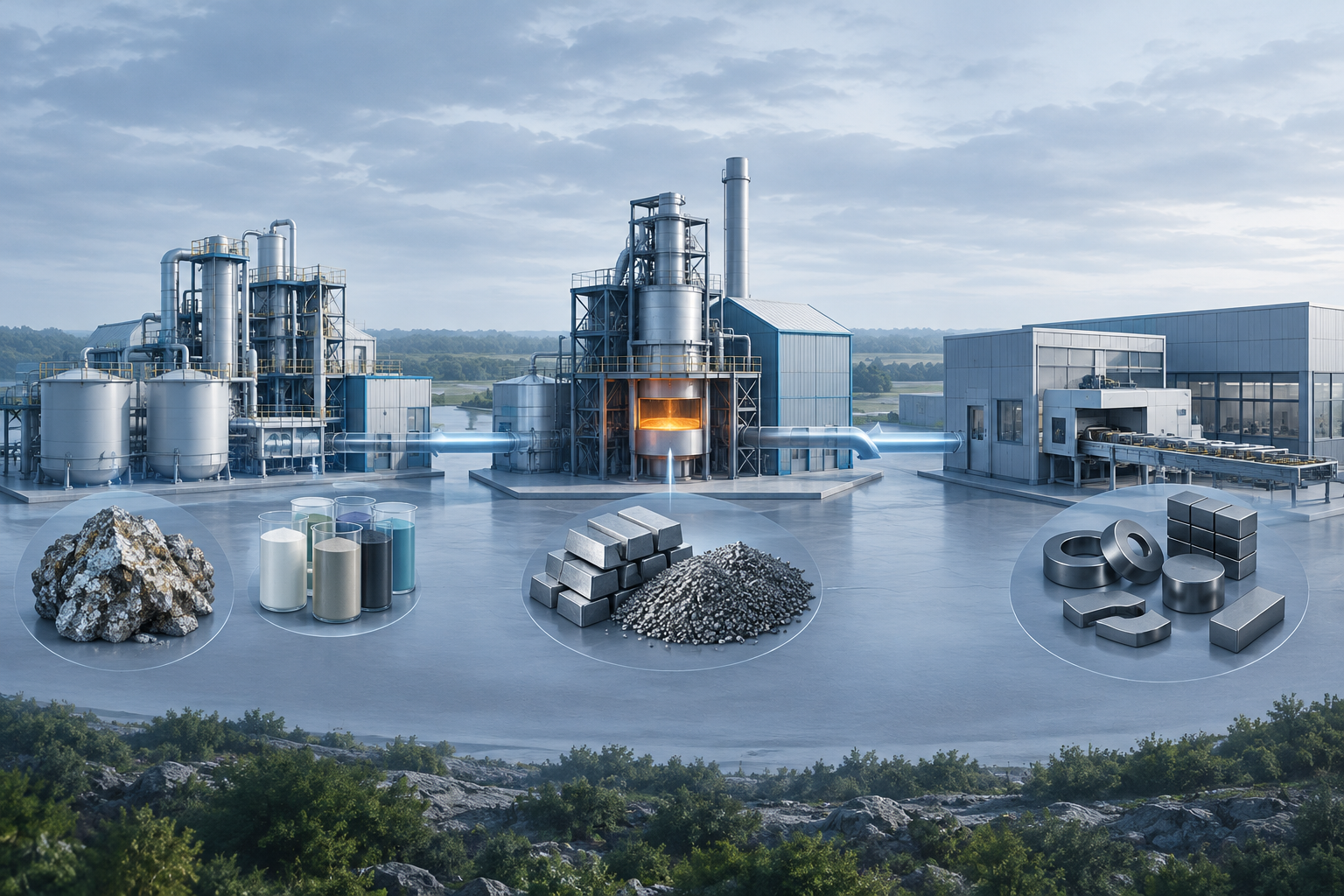
Neo’s planned Project GAUSS would add up to 3,000 metric tonnes a year of magnet capacity in Estonia while connecting rare-earth separation, metal production and magnet manufacturing. The integrated design could reduce European supply-chain handoffs, but delivery depends on grant contracting, financing and final investment decisions.
On 19 October 2026, Neo Performance Materials announced that its Project GAUSS in Estonia had been selected for support of up to €126 million under the EU Innovation Fund. The Toronto-based rare-earth materials producer was invited to prepare a grant agreement with the European Climate, Infrastructure and Environment Executive Agency, CINEA. GAUSS — “Green Assets from European Union Strategic Supply” — would connect rare-earth separation, metallisation and sintered permanent-magnet manufacturing within a European industrial chain. The expansion would add up to 3,000 metric tonnes of annual magnet capacity, taking Neo’s associated European facility from approximately 2,000 to 5,000 metric tonnes a year.
The strongest industrial rationale for GAUSS is the connection between those processing stages, rather than the magnet-capacity figure alone. A European magnet factory can remain dependent on overseas suppliers for the materials entering its production line. Integrating separation and metal production addresses more of that processing dependency, although the resulting supply-security benefit depends on feedstock sourcing, reliable operation and customer qualification.
What the Estonian processing chain would change
Rare-earth separation, metallisation and magnet manufacturing perform different functions. Separation processes mixed rare-earth feed into individual rare-earth products; it is chemically demanding because the elements have closely related properties. Metallisation then converts separated compounds into metals or metal-containing inputs for alloy production. Availability of separated oxides therefore does not, by itself, establish an industrial capability to manufacture magnets.
Sintered rare-earth magnets use alloys typically containing neodymium and praseodymium, with heavy-rare-earth additions such as dysprosium or terbium depending on performance requirements. Sintering consolidates compacted alloy powder through heat. Converting those inputs into a qualified magnet requires control of composition and manufacturing conditions. Magnet production is consequently the link between a supply of processed rare earths and a usable component for a motor or generator.
GAUSS is designed to coordinate these stages within Neo’s Estonian operations. That could reduce inter-stage transport, supplier interfaces and scheduling mismatches between separated material, metal and finished magnets. Linking batch records across successive transformations could also support traceability, provided operating procedures preserve those links. This is a potential benefit of integration, rather than an established feature of GAUSS’s customer documentation.
This design fits the processing logic of the EU Critical Raw Materials Act. Its 2030 benchmarks include EU processing capacity covering at least 40% of annual consumption of strategic raw materials, and limiting dependence on a single third country to 65% at the relevant processing stage. GAUSS would contribute to regional processing capability, but its magnet tonnage cannot be used to calculate compliance with those EU-wide benchmarks. The planned 3,000-tonne annual addition describes magnet capacity, not separation or metal-production capacity.
Offshore wind defines an intended market, not guaranteed demand
Approximately one-third of GAUSS’s incremental magnet capacity is intended for EU offshore-wind farms. That allocation identifies a downstream application: magnets used in direct-drive and other high-performance generator designs. Electromobility and industrial automation are further intended applications for the planned European magnet supply.
For turbine and generator manufacturers, the relevant output is a qualified component delivered to specification and schedule. Annual tonnage is only one measure of capability. Magnetic performance, dimensions, coatings and consistency must match the customer’s equipment design before nominal capacity becomes usable supply. Offshore-wind demand also depends on generator architecture; not every turbine design requires the same magnet content.
The intended wind allocation therefore gives the expansion an industrial focus without establishing a guaranteed sales volume. Project delays, financing conditions for offshore developments and changes in turbine procurement can alter demand timing. The commercial significance of the allocation depends on customer qualification and purchasing commitments, rather than an earmarked share of capacity alone.
What grant selection changes — and what remains to be financed
Neo estimates GAUSS’s project value at approximately €400 million. At its full €126 million ceiling, the proposed Innovation Fund grant would cover less than one-third of that amount. Selection creates a route to substantial public support, but the remaining capital would still require equity, debt, strategic participation, customer funding or another financing combination. These are possible funding routes, not an announced financing structure.
The October 2026 milestone was selection and an invitation to prepare the grant agreement, rather than completed contracting or disbursement. Final investment decisions remain outstanding. CINEA’s target for signing the grant agreement is 23 March 2027; that administrative target does not set a construction-start or commercial-production date. The indicative project duration is approximately two to three years following the required investment and funding decisions.
The credible counterargument to the integration strategy is that it combines several demanding investments before the chain can deliver its full intended benefit. Chemical separation, metal production and high-specification magnet manufacturing have different process controls, environmental obligations and specialist staffing requirements. Financing and commissioning must support a functioning chain, rather than simply complete individual installations.
The increase from approximately 2,000 to 5,000 metric tonnes a year is a nameplate-capacity objective: designed annual capacity, not guaranteed production or sales. Achieving saleable output requires feedstock availability, stable alloy chemistry, acceptable yields, equipment uptime and customer qualification. Grant conditions, permitting, equipment procurement or qualification delays could extend the schedule even after funding agreements are signed.
Integration reduces handoffs but can concentrate disruption
A diversified chain of specialist plants offers a legitimate alternative to deeper integration in Estonia. Separate suppliers can provide substitution routes when one processor is unavailable, although maintaining those routes requires additional logistics, contracts and quality-system coordination. An integrated chain simplifies those interfaces but can transmit an upstream outage directly into downstream production.
A decisive operational question is therefore whether Neo’s magnet operations could use qualified external metals or alloys when an internal stage is interrupted. If substitution requires lengthy requalification, the reduction in cross-border handoffs could come at the cost of greater dependence on the integrated operating chain. Qualified backup supply would strengthen the resilience case.
Feedstock origin is a separate boundary. Processing in Estonia establishes European manufacturing activity; it does not establish that the underlying rare earths were mined in Europe. Assessing GAUSS’s contribution to supply diversification therefore requires the upstream sourcing mix as well as the location of conversion. Integration could relocate several processing stages to Europe while leaving exposure to concentrated raw-material supply. Its operational benefit would also be constrained if one processing bottleneck persistently restricted downstream output.
Conclusion
GAUSS has a stronger industrial rationale than a magnet-only expansion because it addresses the conversion stages between rare-earth feed and a qualified industrial component. Realising that advantage depends on grant contracting, the remaining financing and execution across three distinct processing activities. The meaningful outcome will be dependable, customer-qualified supply supported by workable feedstock and backup arrangements — not installed capacity alone.
Sources
- Neo Performance Materials: Project GAUSS selection under the EU Innovation Fund, 19 October 2026.
- Neo company announcement distributed through FT Markets: project scope, capacity and indicative timetable.
- Baltic Focus: Estonian magnet project funding and estimated investment, 20 October 2026.
- Mining South East Europe: GAUSS grant-contracting and investment status, 27 October 2026.
- European Commission: Critical Raw Materials Act and 2030 benchmarks.