
DPA Title III has become a core U.S. mechanism for expanding critical minerals capacity where commercial markets alone have not delivered sufficient domestic or allied supply. The substantive shift is not simply more public funding; it is the use of a national security statute to support mining, processing, separation, refining, and magnet or battery-material capacity through tailored financial instruments rather than standard procurement alone.
For policy and institutional readers, the significance is structural. Title III is designed to address industrial shortfalls that affect defense readiness and supply-chain resilience. In critical minerals, that usually means support for bottleneck stages of the value chain, especially midstream processing, where the United States has often remained dependent on foreign capacity even when upstream resources exist.
Key Takeaways
- DPA Title III is a legal authority under the Defense Production Act used to expand industrial capacity tied to national defense, including critical minerals and related processing.
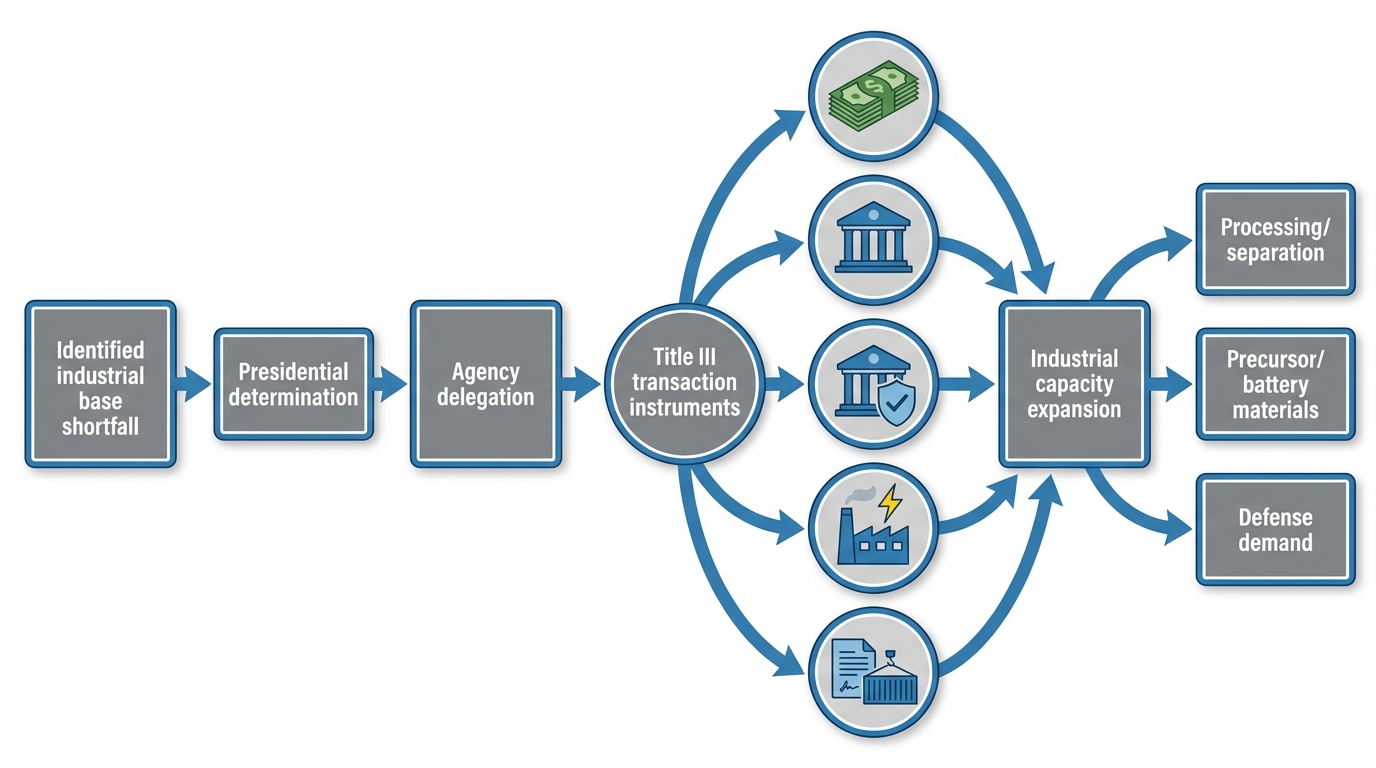
- The program can use grants, loans, loan guarantees, purchase commitments, and direct capital support depending on the project structure and the identified supply shortfall.
- Publicly announced awards show a clear emphasis on downstream and midstream bottlenecks such as rare earth processing, magnets, and battery materials, not only mine development.
- DoD stated that since mid-2023 it awarded a total of $250 million to twelve recipients using IRA-appropriated funds through the DPA Purchases office for strategic and critical materials tied to battery supply chains.
- The main execution signals to monitor are permitting progress, construction milestones, qualification of output, compliance conditions, and whether supported projects secure durable non-federal commercial demand.
What DPA Title III Is
Title III of the Defense Production Act is the part of the statute focused on domestic industrial base expansion. It is meant for situations where a material, component, or capability is considered important to national defense and the private market is not supplying enough capacity, fast enough, or in the required form. That makes it particularly relevant to critical minerals, where long project lead times, high capital intensity, difficult qualification processes, and concentrated foreign processing can leave major supply gaps unresolved for years.
In practical terms, Title III is not a conventional purchasing program for finished goods. It is an industrial policy tool that allows the U.S. government, usually through the Department of Defense, to support new capacity creation. The emphasis is often on building or scaling facilities that can convert raw materials into defense-usable products.
Legal Authority and Trigger Conditions
The legal foundation matters because Title III is not an open-ended subsidy program. Its use is tied to a formal determination that an industrial shortfall exists and that government action is necessary to create, maintain, protect, expand, or restore domestic industrial base capabilities essential for national defense. Authority can be delegated to the Secretary of Defense and implemented through the offices responsible for DPA Purchases and related industrial base programs.
This framework gives the Pentagon flexibility, but it also imposes discipline. Support is supposed to be linked to a defined capability gap rather than broad sector promotion. In critical minerals, that distinction explains why awards often focus on separation, refining, precursor production, metallization, or magnet manufacturing rather than undifferentiated upstream activity.
How Awards Are Structured
DPA Title III awards can take several forms. Grants are the most visible. They reduce upfront capital risk and are often used when a facility has strategic importance but uncertain near-term commercial returns. Loans and loan guarantees are another option, particularly where a project has identifiable future cash flow but cannot easily secure private debt on acceptable terms. Purchase commitments can also be used to create demand certainty, which is often as important as capital support in minerals markets with limited domestic offtake depth.
Direct capital support can have an equity-like effect even when it is not common equity in the corporate sense. The government may fund plant buildout, equipment, or expansion in ways that materially strengthen a project’s financing stack. In many cases, awards are milestone-based rather than fully disbursed at signature. That means engineering, permitting, construction, commissioning, or qualification milestones can determine the release of funds.
These structures matter because critical minerals projects often fail at the transition between concept, financing, and operational qualification. A Title III award can bridge that gap by combining public capital, signaling strategic priority, and improving a project’s ability to attract complementary private financing.

Why Critical Minerals Fit the Program
The critical minerals case is driven by concentration risk. For several minerals and processed products, mining may be geographically distributed while refining, separation, or manufacturing remains heavily concentrated in a small number of jurisdictions. That creates exposure not only to trade friction and logistics disruption, but also to technology transfer limits, sanctions risk, export controls, and qualification delays for defense-grade materials.
Rare earths are the clearest example. The strategic issue is not only ore production. The more sensitive choke points are chemical separation, metal production, alloying, and magnet manufacturing. The same logic applies across battery materials, where precursor and processing stages can be more difficult to localize than mining itself. Title III is so well matched to bottlenecks that are commercially difficult but strategically important.
What Announced Awards Show
Public announcements do not provide a full tracker of all DPA activity, and they rarely disclose every contractual term. Even so, they offer a useful picture of policy direction. The Department of Defense has stated that since mid-2023 it awarded a total of $250 million to twelve recipients using Inflation Reduction Act appropriated funds through the DPA Purchases office to support domestic manufacturing capability for strategic and critical materials tied to large-capacity batteries. That indicates breadth across materials and a clear effort to connect defense resilience with industrial capacity relevant to electrification.
The MP Materials partnership is another widely cited example of Pentagon rare earth investment associated with Title III authorities. Its significance is less about mining alone than about downstream rare earth processing and magnet-related capacity. That is consistent with the broader pattern in U.S. critical minerals funding: the federal government is increasingly focused on the stages that determine whether mined material can actually become qualified domestic supply.

Operational and Compliance Implications
For supply-chain and institutional analysis, a DPA award is best understood as a capability signal rather than proof of immediate output. Announced support can reduce financing risk, but execution remains exposed to permitting timelines, equipment delivery, technical ramp-up, feedstock availability, and customer qualification. In critical minerals, commercial success also depends on whether the supported facility can integrate with upstream feed sources and downstream buyers in a stable way.
Compliance considerations are equally important. Projects operating under Title III support may face reporting obligations, domestic sourcing conditions, audit requirements, and other federal oversight mechanisms. Those factors can strengthen traceability and resilience, but they can also lengthen execution timelines relative to purely private projects.
What to Watch
The most important signals are not limited to award announcements. Market participants typically watch whether funded projects reach construction and commissioning milestones, whether output qualifies for defense or industrial use, whether additional federal instruments are layered onto the initial award, and whether supported capacity develops durable commercial demand outside direct government backing. Those indicators show whether Title III is merely allocating funds or actually changing the shape of the U.S. critical minerals base.
The central conclusion is straightforward: DPA Title III critical minerals funding is a targeted industrial expansion mechanism built for strategic bottlenecks. Its role is not to replace markets, but to intervene where markets have left defense-relevant mineral capacity underbuilt. The announced awards suggest a consistent policy logic focused on midstream processing, downstream manufacturing, and reduction of concentrated foreign dependency rather than simple headline support for extraction alone.