
Production interruptions tied to neodymium magnet feed, gallium wafer inputs, lithium chemicals, or antimony compounds rarely begin with a single dramatic shortage. In many operating environments, the first signal is quieter: a supplier quotation window that suddenly narrows, a certificate of origin that no longer identifies the processing node, a component maker that can ship assemblies but not disclose the oxide, alloy, or precursor route behind them. In critical metals, the fragile point is often not the mine itself. It is the separation plant, the refining circuit, the tolling arrangement, the export licence, the logistics corridor, or the embedded dependency inside a subassembly. That operating reality is what makes “critical metals explained” a supply-chain discipline rather than a glossary exercise.
Key takeaways
- Critical metals risk often sits in processing, refining, and component fabrication rather than mining alone.
- Apparent supplier diversification can be misleading when multiple vendors rely on the same refinery, separator, or magnet maker.
- Observed resilience measures include route mapping, alternate qualification, inventory buffers, secondary feed, recycling, and tighter document control, each with visible limits.
- Executive visibility usually improves when risk is measured through concentration, traceability, compliance status, specification stability, and timeline exposure rather than headline market noise alone.
Critical metals explained in operational terms
Strategic metals, critical minerals, and critical metals are often used interchangeably in board papers, but the operating meaning is more specific: materials with concentrated supply chains, limited substitution, and high importance to manufacturing continuity. The group spans rare earth elements such as neodymium and dysprosium, battery metals such as lithium, cobalt, and nickel, and speciality inputs including gallium, germanium, and antimony. For magnet users, semiconductor manufacturers, aerospace programmes, and battery supply chains, the relevant question is not only whether a metal is available in geological terms. The sharper question is where separation, refining, alloying, and component conversion are concentrated.
Industry and policy materials cited in 2024-2025 describe China as controlling 91% of refined rare earth elements and 92% of rare earth magnets, alongside significant refining shares in nickel, lithium, and cobalt. Late-2024 Chinese export bans on gallium, germanium, and antimony for the U.S. context reinforced a point already familiar in practice: mine ownership does not remove processing dependence. In supplier files, common technical abbreviations include TREO for total rare earth oxides, LCE for lithium carbonate equivalent, MT for metric tonnes, and ppm for parts per million in impurity or contamination limits. Those terms matter because qualification failures often arise from chemistry and purity drift rather than from the metal family name alone.
Exposure mapping: defining the real dependency
Exposure mapping usually has three layers. The first is direct metal use in the bill of materials: oxides, carbonates, salts, alloys, powders, and sponge. The second is chemical or metallurgical intermediates embedded in purchased materials, such as cathode precursor, sputtering targets, or magnet alloys. The third is hidden dependence inside finished components bought from third parties. One recurring discovery in supplier reviews is that the legal seller and the decisive processing node are frequently different entities. A battery material sold by a regional distributor may still depend on a single Asian conversion line; a “non-Chinese” component may still contain Chinese-separated rare earths or Chinese-made magnets.

- Material identity at the technical level: oxide, carbonate, metal, alloy, precursor, or finished component.
- Process step that determines bottleneck risk: mining, separation, refining, alloying, sintering, wafering, cathode production, or magnet manufacturing.
- Country sequence across the route: extraction, processing, conversion, assembly, and export.
- Document trail: certificate of origin, safety and specification sheets, sanctions and export-control screening, and any proof of processing location.
- Specification sensitivity: purity, contaminant limits in ppm, performance tolerance, and requalification burden if chemistry changes.
The EU Critical Raw Materials Act is often referenced in internal risk discussions because it frames concern around excessive dependence on a single third country at the Union level, with a 65% benchmark frequently cited. In practice, however, company exposure is usually more granular than a single policy threshold. A manufacturer can have modest country concentration at a portfolio level and still face acute dependence in one critical node, such as heavy rare earth separation or antimony oxide conversion. Another recurring discovery is that supplier questionnaires often capture mine origin but not toll processing, subcontract separation, or intermediate storage. That gap matters because disruptions often emerge in those middle stages first.
Supplier diversification: what actually changes risk
In observed supply-chain reviews, diversification is strongest when it separates jurisdiction risk, processing risk, and specification risk rather than merely increasing the vendor count. Two qualified suppliers can still represent one real point of failure if both rely on the same separator, refiner, port, or logistics corridor. Rare earths illustrate this clearly: mine output in Australia or the United States can still leave a buyer exposed if the separation, metalmaking, or magnet conversion step remains concentrated elsewhere. Lithium presents a similar pattern when brine, spodumene, conversion, and cathode precursor production sit in different jurisdictions with different regulatory and logistics profiles.
Observed options for diversification include multi-jurisdiction sourcing, alternate processing nodes, secondary feed from scrap or recycling, and design-level substitution where qualification barriers are manageable. Each option carries trade-offs. Multi-jurisdiction sourcing can reduce geopolitical concentration while increasing quality variation. Secondary feed can improve circularity and local availability while introducing chemistry variability and traceability questions. Substitution can reduce dependence on one metal family while creating fresh qualification work in performance-critical applications. In aerospace and semiconductor contexts, the qualification burden alone can be the dominant constraint, especially where ppm-level contamination affects yield or certification status.
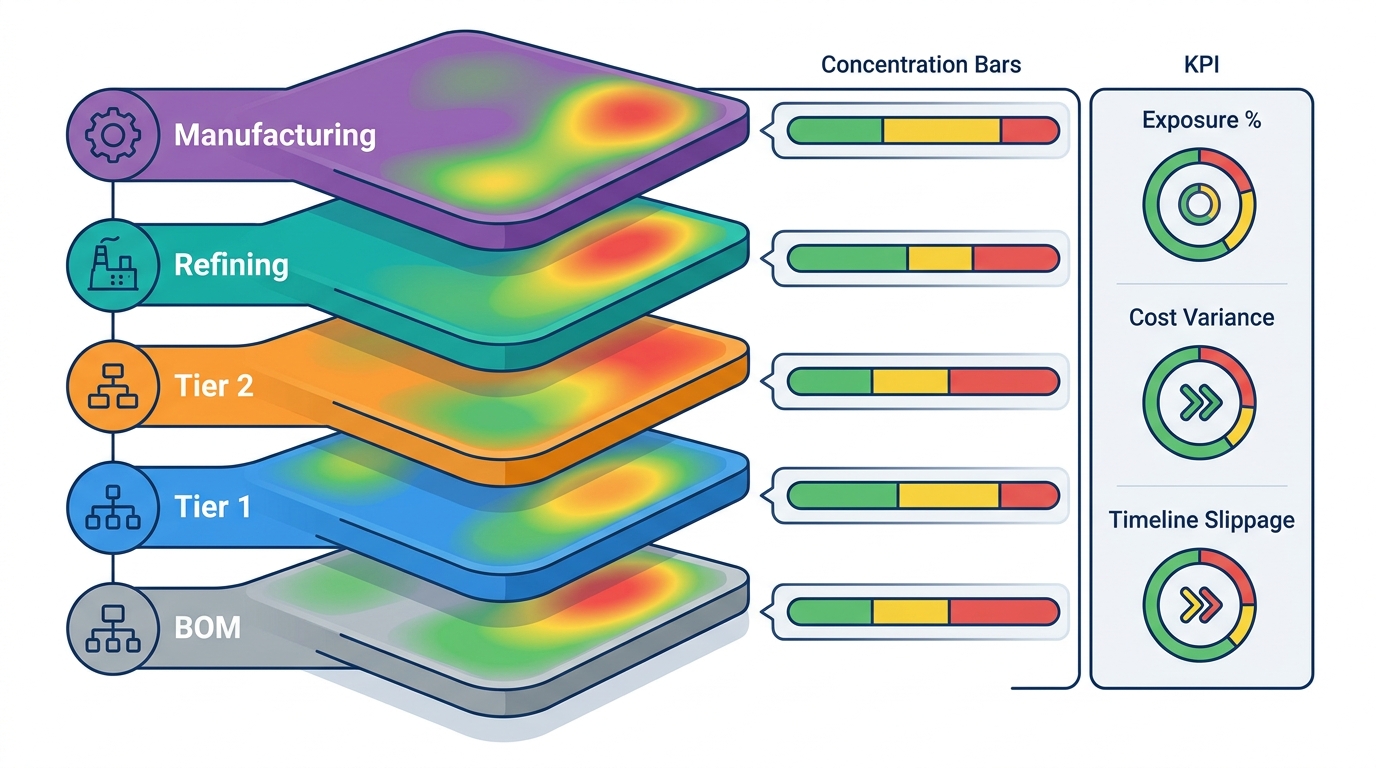
Jurisdiction screening in 2024-2025 has commonly focused on Australia, Canada, the United States, Chile, and selected African producers, while keeping close attention on the processing concentration that still sits in China for many metal families. A recurring operating lesson is that geographic variety at the mine stage does not automatically translate into route resilience. True diversification tends to appear only when refining, conversion, and component fabrication are also deconcentrated.
Contract structures and document controls as observed risk tools
Because the brief includes contracts and cost monitoring, it is useful to distinguish paper resilience from physical resilience. Longer-term supply agreements, nominated alternate origins, milestone-based volume ramps, and force-majeure language that names export controls or sanctions events are all observed in critical metals supply chains. Their practical value depends on whether the contracted source is technically qualified and whether the documentation matches the real process route. A contract that secures volume from a supplier still leaves exposure intact if the same upstream refiner serves every “alternate” source listed on paper.
Document control often reveals more than headline commercial terms. Common review points include origin disclosure, proof of processing location, sanctions screening, product stewardship documentation, and change-notification language for chemistry, impurity profile, or subcontracted processing. One recurring discovery is that material can remain “available” contractually while becoming unusable operationally after a change in impurity profile, coating, particle size, or magnetic performance. In that setting, the contractual right exists, but the qualified material stream does not.

Monitoring cost transmission, storage, and project-timeline risk
Cost monitoring in critical minerals is rarely a simple index exercise. Margin pressure often reaches operations through indirect channels: scrap generation after a chemistry change, lower yield, expedited freight, duplicated qualification work, or delayed project milestones. A rare earth oxide benchmark may move one way while the magnet, alloy, or finished motor input moves differently; the same pattern appears in battery chains when lithium chemicals, precursor materials, and finished cells adjust on different timing. That is why many operating dashboards combine market signals with physical indicators.
- Share of demand linked to a single country, refiner, or component maker.
- Portion of supply with verified processing-route documentation.
- Status of alternate-source qualification at the exact required specification.
- Days of cover by material family and by stored form, such as oxide, carbonate, metal, alloy, or finished component.
- Quality drift indicators, including impurity excursions in ppm, yield loss, or customer returns linked to material change.
- Timeline exposure, including projects dependent on a single unqualified route or on export-licence continuity.
Storage is another area where observed practice varies sharply by metal family. Some organisations hold buffer inventory in upstream form, such as oxide or carbonate, to preserve flexibility. Others hold alloy, powder, or finished components to reduce conversion uncertainty. The trade-off is straightforward: upstream inventory offers optionality but still relies on downstream processing access; finished-component inventory reduces processing risk but narrows flexibility and can create obsolescence or specification-change exposure. For hazardous, moisture-sensitive, or purity-sensitive materials, storage conditions become part of resilience analysis rather than a warehouse afterthought.
Frequent failure modes in executive reviews
- Supplier count is mistaken for route diversity, even though the same refinery or separator sits behind multiple vendors.
- Mine geography is mapped, but conversion, tolling, and component fabrication are left untraced.
- Commercial availability is treated as equivalent to qualified availability, despite unresolved ppm, purity, or performance issues.
- Buffers exist in the wrong form, protecting one step of the chain while leaving the real bottleneck untouched.
- Compliance and trade-control risk is reviewed after sourcing decisions, not as part of the original route definition.
When critical metals supply resilience is analysed at operating level, the central question is usually simple: where is the single point of failure that the current reporting line does not show? For rare earth magnets, the answer often lies in separation or magnet making. For gallium, germanium, and antimony, it may sit in export controls and speciality processing. For lithium, cobalt, and nickel, it may sit in the conversion and precursor stages rather than at the mine. That framing turns critical metals explained from a market topic into a practical method for protecting continuity, margin stability, compliance status, and project timing.