
When a shipment clears customs yet still cannot enter production, the root cause is often not the mine. In critical metals, disruption commonly appears one or two steps later: at separation, refining, alloying, or in the document trail that proves lawful origin and compliant movement. That operational reality matters for family offices, private wealth advisers, and physical commodity buyers examining critical minerals supply risk. A metal becomes “critical” not because it sounds scarce, but because an industrial system depends on it, substitutes are limited, and supply is concentrated in places, companies, or process steps that can fail abruptly.
- Criticality is usually a combination of economic importance, concentrated supply, and low substitutability rather than simple geological rarity.
- Mine diversification can disappear at the refining stage; processing bottlenecks often create more practical risk than upstream ore availability.
- Physical due diligence extends beyond assay results to origin evidence, export licensing, chain of custody, storage controls, and sanctions screening.
- Observed resilience tools include stockpiles, alternate processors, recycled feed, route diversification, and specification flexibility, each carrying different trade-offs.
- Current policy signals include the EU Critical Raw Materials Act, Chinese export licensing on selected materials, and U.S. sourcing rules tied to battery materials after 2026.
What makes a metal critical or strategic in practice
Public definitions vary by jurisdiction, but most frameworks converge on three tests: the material has a high role in industrial activity, supply is vulnerable to concentration or disruption, and substitution is difficult without loss of performance or requalification time. “Strategic” often adds a defense dimension. Uranium historically sat at the center of state strategy during the Manhattan Project era; today, lithium is central to battery manufacturing. Tungsten is frequently classed as strategic because of hard metal and defense applications. Rare earths illustrate the distinction well: some are critical because of magnet demand and processing concentration, while a rare element such as osmium has limited industrial scale and so a very different risk profile.
Another recurring discovery in real reviews is that not all critical materials are rare, and not all rare materials are critical. Copper is geologically widespread, yet logistics disruptions tied to war, power constraints, permitting delays, and refinery outages can still make copper a critical bottleneck for grids, electrification, and wiring. The label therefore reflects system dependence more than crustal abundance. Public methodologies often use concentration metrics such as the Herfindahl-Hirschman Index, with high values indicating supply concentration, but the industrial question remains more practical: where does usable material actually come from, in what form, under which documentation, and through which processor?
The risk perimeter: ore body, processor, form, and route
A reliable review usually maps the material across its full chain rather than stopping at mine ownership. In rare earths, a deposit may report TREO, meaning total rare earth oxides, but downstream exposure often sits in the NdPr split or in access to dysprosium and terbium for high-temperature magnets. A high-TREO concentrate is not the same as a separated oxide usable in magnet chemistry. In lithium, project descriptions may use LCE, or lithium carbonate equivalent, yet the relevant issue for many downstream uses is conversion capability into the required salt or precursor. In specialty metals, impurity thresholds measured in ppm can decide whether a batch is acceptable or rejected.
That difference between resource and usable form is one of the most common moments of discovery in diligence work. A diversified upstream map can appear reassuring until the flow narrows into one refiner, one separation facility, or one alloy producer. China’s role in rare earth separation, graphite processing, and gallium and germanium exports is the clearest current example. The Democratic Republic of Congo may dominate cobalt mining, while refining control sits elsewhere. Indonesia may shape nickel intermediate supply, but battery-grade qualification and environmental scrutiny create a separate risk layer. The practical perimeter therefore includes country, processor, form, route, and qualification status, not just tonnage.
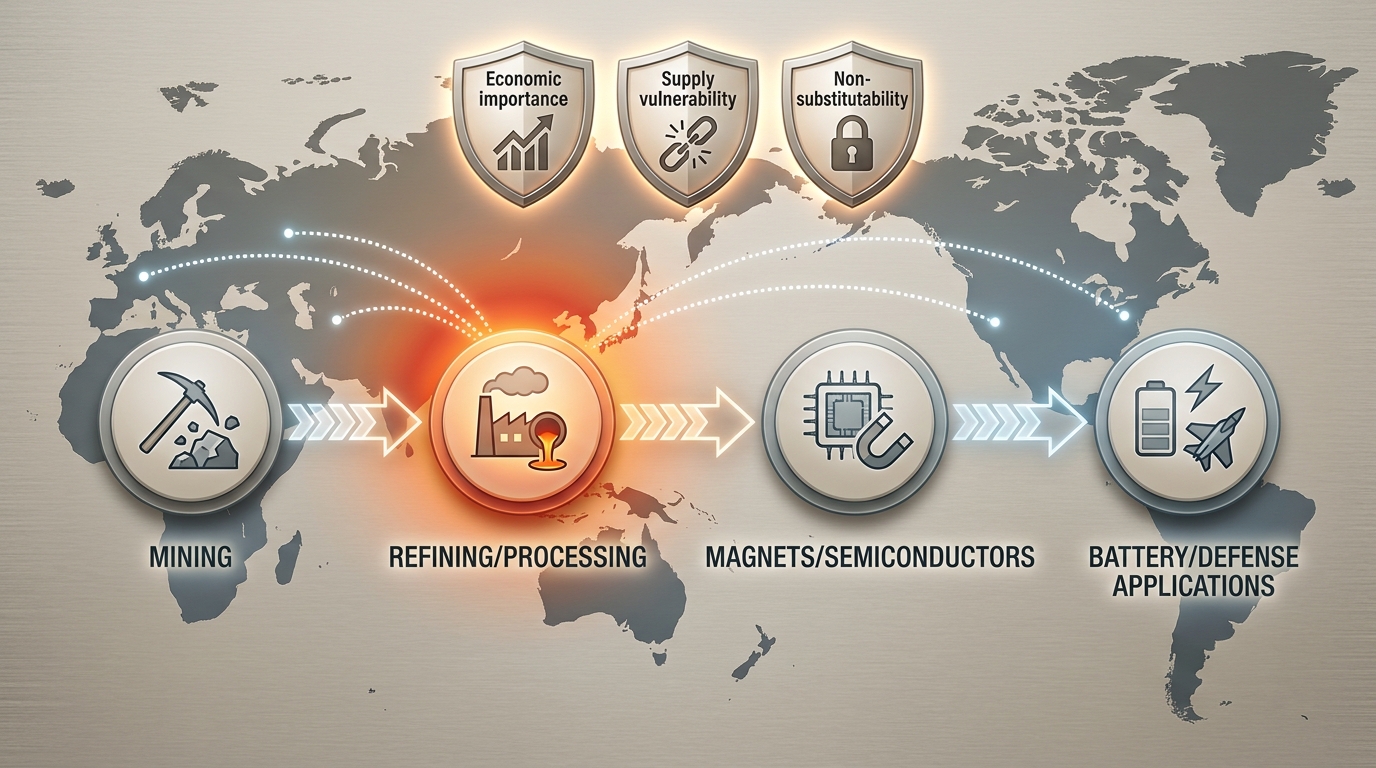
Core criteria used to assess critical metals exposure
A structured assessment usually turns on six criteria. First is supplier concentration by mine, country, and processor. A market with several mines can still behave like a single-source market when one separator or refiner dominates output. Second is processing complexity. Materials that require difficult solvent extraction, high-purity conversion, or specialist alloying tend to carry longer disruption tails because new capacity cannot be qualified quickly. Third is substitutability. A metal used in a high-performance magnet, battery chemistry, turbine alloy, or semiconductor layer may have no near-term replacement without redesign and requalification.
Fourth is compliance and documentation. In practice, document packs often determine whether a material is actually deliverable. Typical files include assay certificates, certificate of origin, export permits where applicable, sanctions screening records, conflict-minerals declarations, safety data sheets, and warehouse or vault receipts. A second moment of discovery commonly appears here: chemistry may be proven, while lawful origin or custody continuity remains incomplete. Fifth is logistics. Critical metals frequently move through a narrow set of ports, transshipment hubs, and ocean routes. Congestion in Singapore, Busan, or other major hubs can have different implications from a disruption in the South China Sea or the Red Sea. Sixth is policy exposure. The EU Critical Raw Materials Act, Chinese export licensing on gallium, germanium, and graphite, and U.S. battery sourcing rules all shape the usable map of supply.
Failure modes observed across critical metals supply chains
The most frequent failure mode is the hidden single point of failure. Rare earth concentrate may be available, but separation capacity remains concentrated. Nickel intermediate may be plentiful, but a single conversion route into battery-grade material can tighten the whole chain. A second failure mode is form mismatch. Market commentary may treat oxide, metal, alloy, and finished component as interchangeable, while downstream plants do not. A third failure mode is specification drift. Impurity levels, moisture content, particle size, or isotope profile can push a batch outside qualification even when the headline material name looks correct.
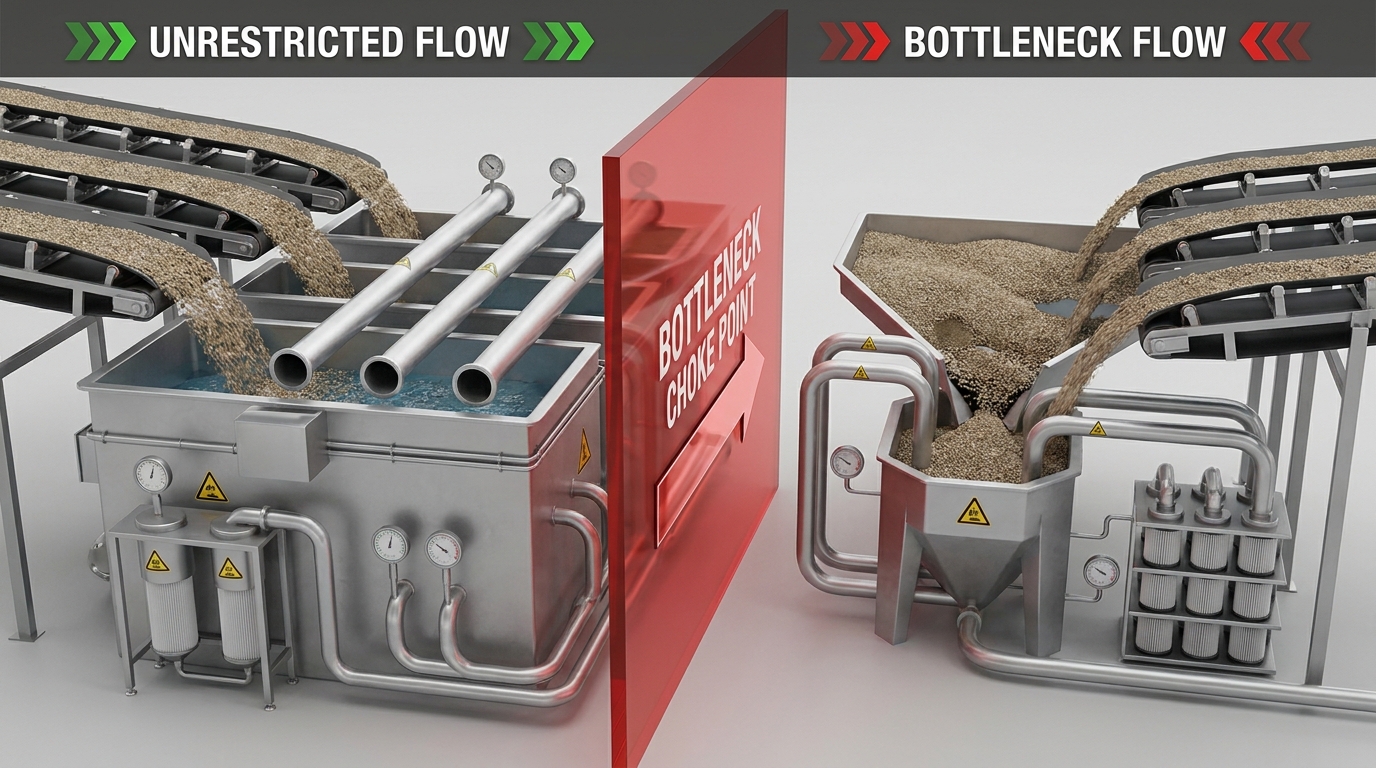
A fourth failure mode is documentary interruption. Export controls do not always ban material outright; they can impose licensing, end-use checks, or additional scrutiny that slows movement materially. The gallium and germanium measures introduced by China in 2023, followed by broader graphite licensing in 2025, fit this pattern. A fifth failure mode is jurisdictional or social license disruption: environmental permitting, local opposition, labor action, power constraints, and scrutiny around artisanal or conflict-linked supply can all interrupt flow. Cobalt from the DRC, nickel from Indonesia, and rare earth processing in Malaysia each illustrate a different version of that risk. A final failure mode is custody ambiguity. Metal stored in bonded warehouses or third-party facilities can look secure on paper while audit rights, title clarity, or withdrawal procedures remain uncertain.
Observed resilience configurations and their trade-offs
Several risk-management patterns appear repeatedly in practice. One is inventory buffering through strategic stockpiles or larger working inventories. This can reduce exposure to short licensing delays or shipping disruption, but it increases storage, insurance, and audit complexity. Another is dual geography: upstream material from one jurisdiction and processing in another. Australia-to-Malaysia rare earth flows and South American lithium combined with non-Chinese conversion efforts reflect that approach. The trade-off is that political diversification can introduce more interfaces, more qualification work, and more documentation.
Recycled feed is another observed option, especially in magnets, battery black mass, tungsten, and certain electronic metals. Recycling can soften primary supply shocks, though feed consistency and recovery yields vary. Specification flexibility also appears in resilient systems: a buyer or industrial operator with more than one qualified chemistry, alloy, or component design often has more room to respond when a narrow grade disappears. Finally, physical custody and traceability are frequently treated as resilience tools rather than mere back-office controls. Segregated storage, independent assay verification, and periodic inventory audit can reduce ambiguity when supply is tight and substitution is limited.

A practical review sequence for family offices and institutions
A typical review sequence contains five passes. The first pass defines the exact material and form under consideration: oxide, carbonate, metal, alloy, precursor, magnet, or component. The second maps concentration by country, company, and processing step, with attention to whether apparent upstream diversity collapses at conversion or separation. The third tests documentation: origin evidence, export permissions, sanctions status, conflict-minerals exposure, REACH or equivalent compliance where relevant, and storage records. The fourth identifies failure modes that are realistic for that chain, including policy shifts, processing outages, qualification delays, and route concentration. The fifth compares the resilience configurations already visible in the market, along with their operational compromises.
For family offices with indirect exposure through owned businesses or industrial holdings, this sequence often reveals that criticality sits inside a supplier’s supplier rather than in the headline commodity itself. That is especially common in rare earth magnets, battery precursor chains, and semiconductor materials. Related reading within Procyon Metals includes the rare earth magnets guide and the physical strategic metals due diligence checklist, both of which extend the same framework into narrower categories and document-level review.
Closing perspective
Critical metals are best understood as supply-chain systems rather than scarcity stories. Concentration, processing difficulty, export controls, custody, and documentation often matter more than reserve headlines. For institutions requiring a structured review of supplier concentration, processing exposure, chain of custody, and policy-sensitive bottlenecks, a strategic metals due diligence conversation with Procyon Metals is available.