Project Vault as an Industrial Continuity Signal
In the briefing materials supplied for this analysis, Project Vault is presented as a U.S.-backed effort, announced in February 2026, to assemble a critical minerals stockpile with support from private capital and Export-Import Bank financing. Even if the final institutional form evolves, the operational issue is already clear. A critical minerals stockpile only protects real-world hardware deployment when the material inside that stockpile is in the right chemical form, at the right purity, with the right documentation, and already accepted by downstream manufacturing lines.
That is the paradox at the center of the current Project Vault critical minerals debate. U.S. policy seeks lower dependence on Chinese supply chains, yet the same policy may require near-term purchases of China-refined material because the non-Chinese upstream base remains too thin in qualified midstream processing. For CIOs, infrastructure leaders, procurement teams, and data-center operators, this is not an abstract geopolitical contradiction. It is a bill-of-materials problem that flows directly into lead times, deployment schedules, and component cost inflation.
The paradox is not political inconsistency. It is midstream physics.
Critical-mineral dependency is often described as if mine ownership were the decisive variable. In practice, the choke point sits further downstream. Gallium and germanium require recovery, purification, and qualification steps that are technically demanding and environmentally burdensome. Rare-earth magnet materials depend on separation chemistry, alloying, powder metallurgy, and sintering capacity. Cobalt supply is shaped not only by mine output from the Democratic Republic of the Congo, but by conversion into battery-grade salts and precursors. A stockpile built around raw material without those processing steps remains a geological asset, not an operational buffer.
Why Reducing China Dependence Still Pulls Through China in the Short Term
The explanation begins with process flow rather than policy language. Germanium is commonly recovered as a by-product from zinc-processing residues, fly ash, or other secondary streams. Gallium is often recovered from Bayer liquor in alumina refining or from associated industrial streams. Neither metal behaves like a primary mine product that moves cleanly from ore body to finished inventory. The upstream asset may be non-Chinese, but the material frequently appears first as low-concentration content embedded in concentrates or residues. Moving from that stage to semiconductor-grade or optics-grade output requires leaching, chlorination or hydrochloric chemistry, solvent extraction or ion exchange, hydrolysis, precipitation, distillation, and in some cases zone refining to reach 5N purity, or 99.999%, and above.
That sequence explains why China retains such leverage. The issue is not merely installed nameplate capacity; it is the clustering of engineering know-how, reagent supply, effluent treatment capability, and customer qualification history. A refinery handling chloride circuits, arsenic-bearing intermediates, acid regeneration, and waste streams under commercial conditions is difficult to replicate quickly in North America or Europe. Permitting extends timelines. Qualification by semiconductor, optics, magnet, and battery customers extends them further. The result is a structural lag between the desire to diversify and the ability to deliver qualified material at scale.
The materials provided for this brief cite U.S. Geological Survey and related industry references indicating very high Chinese shares in the processing of gallium, germanium, and rare-earth intermediates. Even where mining shifts toward Africa, Australia, or North America, the decisive refining step often remains in China or in Asia-based circuits linked to Chinese technology, reagents, or toll-processing relationships. That is why a U.S. critical minerals stockpile can, in the short run, contain material sourced from non-Chinese mines whose last transformative step still occurred inside China.
The Kipushi example illustrates the point. In the source package, Kipushi is described as a zinc-concentrate source with embedded germanium and gallium potential. That matters. Zinc concentrate is not the same thing as qualified germanium metal or gallium metal. If the contained germanium sits in ppm levels within a concentrate, the supply chain still needs smelting, residue recovery, purification, and end-use qualification before that material can support fiber-optic systems, compound semiconductors, or defense-adjacent optical hardware. The key realization appears when ore chemistry is mapped to hardware qualification: a non-Chinese mine does not automatically create a non-Chinese supply chain.
Exactly the same logic applies to rare-earth magnets. Mine output or mixed rare-earth carbonate is upstream success, but NdFeB magnet availability depends on solvent extraction of NdPr oxides, conversion to metal, strip casting, hydrogen decrepitation, jet milling, magnetic alignment, sintering, machining, coating, and final component integration. The magnet is the industrial product that enters pumps, fans, actuators, and motor assemblies. Stockpiling separated oxides is useful. Stockpiling finished magnets is operationally different, because magnet geometry, coercivity, coating integrity, and customer-specific qualification all matter.
A stockpile of concentrate is geological contingency. A stockpile of qualified 5N gallium is operational continuity.
Hardware Exposure: Semiconductors, Data Centers, Batteries, and Defense-Adjacent Systems
The semiconductor link is frequently misunderstood. Gallium exposure in AI infrastructure does not primarily mean that the main accelerator die is fabricated from gallium compounds. The more persistent exposure often sits in adjacent layers of the system: power electronics, radio-frequency components, optoelectronics, and specialized compound-semiconductor devices in communications and control architectures. The research summary supplied for this brief cites a potential 20% cost increase in gallium-arsenide wafers associated with NVIDIA H100-related supply chains if China quotas tighten. Whether that exact product mapping holds across all configurations, the larger point stands: AI clusters absorb gallium risk through the surrounding ecosystem of power conversion, networking, and high-frequency electronics.
Germanium matters differently. It appears in infrared optics, fiber-optic applications, photonics, and defense-adjacent imaging systems. In data-center settings, the direct exposure may be less visible than in defense or aerospace, but germanium-related bottlenecks still ripple into secure communications, optical subsystems, and sensor infrastructure that overlaps with government workloads, high-performance compute installations, and resilient telecom links. Once export controls tighten, the disruption does not remain confined to a narrow defense silo. It leaks into the wider industrial base that supports cloud, telecom, and advanced electronics.
The data-center impact becomes especially tangible in liquid cooling and electromechanical balance-of-plant systems. The research package notes that neodymium magnets used in liquid-cooling systems, including assemblies associated with suppliers such as Vertiv and Chilldyne, draw on a supply base that is still heavily China-centered. That point surprises many infrastructure teams because rare-earth exposure is often framed around electric vehicles and wind turbines. Yet the same NdFeB magnet chemistry is embedded in pumps, motors, fans, valves, and motion-control components that increasingly populate dense compute environments. If Chinese supply remains dominant at roughly the level cited in the research summary, diversification delays can convert rapidly into component lead times of three to six months.
For batteries and backup power, the picture is more mixed. Not every data-center battery carries cobalt exposure; lithium iron phosphate reduces it materially in many stationary systems. But cobalt remains relevant in parts of the battery ecosystem, in precursor conversion, and in defense-adjacent or high-performance chemistries. The source package points to DRC cobalt offtakes that still route through Asian processing chains before reaching battery-grade form. That is the core issue. Mine origin in the DRC may support diversification narratives, yet cobalt hydroxide converted into sulfate or precursor cathode material through Asia-linked networks still leaves the midstream bottleneck largely intact.
Tungsten sits in a quieter category but deserves attention. It appears in chipmaking tools, sputtering targets, high-temperature contacts, shielding, and certain defense-adjacent assemblies. Tungsten rarely dominates boardroom discussion in the same way as rare earths or lithium, yet it can create disproportionate disruption because there are fewer easy substitutions in high-temperature or wear-intensive environments. In supply-chain risk terms, tungsten often behaves like a small line item with outsized operational leverage.
For data centers, the bill of materials remembers every gap in the refining chain.
- Gallium: compound semiconductors, power electronics, RF devices, optoelectronic components, and parts of high-performance networking architecture.
- Germanium: infrared optics, fiber and photonics applications, secure communications hardware, and defense-adjacent sensing systems.
- NdPr / NdFeB: permanent magnets in cooling, pumping, fan systems, actuators, and high-efficiency electromechanical assemblies.
- Cobalt: battery precursor chains, selected stationary storage chemistries, superalloys, and specialized energy-storage systems.
- Tungsten: tooling, shielding, sputtering targets, high-temperature contacts, and selected semiconductor manufacturing applications.
Seen through that lens, a critical minerals stockpile is not just a reserve for miners or smelters. It is an indirect control point for server deployment, cooling-system readiness, backup-power architecture, telecom resilience, and defense-adjacent infrastructure continuity.
What Form of Stockpile Actually Matters?
The most important competitive distinction is not only which country supplies the material, but which stage of the value chain gets buffered. Four broad forms appear in practice: raw ore or concentrate, intermediate chemical products, refined metal or oxide, and finished components. Each form changes the resilience profile.
Raw concentrate offers the broadest geological exposure and can sometimes be secured from non-Chinese mines earlier than refined material. But it leaves the holder exposed to smelter availability, recovery chemistry, tolling slots, waste treatment, and quality variability. If the contained gallium or germanium is not recoverable on a commercially qualified schedule, the stockpile functions more like deferred feedstock than immediate continuity support.
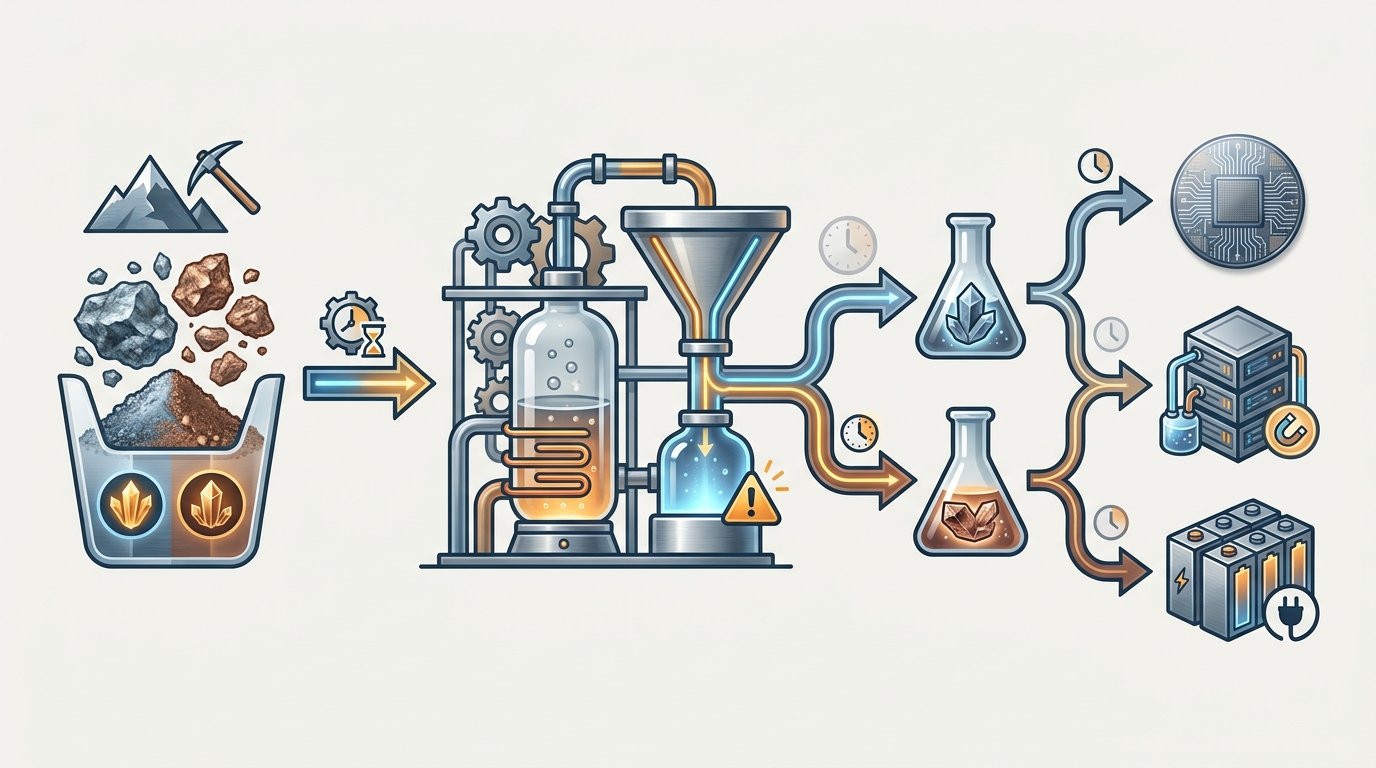
Intermediate chemicals, such as germanium dioxide, rare-earth oxides, cobalt hydroxide, or battery precursor salts, sit closer to manufacturable value. They are easier to assay than complex concentrates and often easier to warehouse than certain metals. Yet they still require conversion capacity. An oxide stockpile preserves optionality on final form; it does not eliminate conversion risk. This matters when downstream users have highly specific impurity tolerances measured in ppm and cannot absorb unplanned substitution.
Refined metal is a stronger continuity instrument. Gallium metal at 5N grade, germanium in qualified form, or battery-grade cobalt salts reduce uncertainty substantially because the most difficult purification stage is already complete. Even here, however, shelf-life behavior, packaging compatibility, and requalification rules matter. Gallium can interact with certain container materials. Magnets can corrode if coatings degrade. Battery chemicals can face moisture sensitivity, contamination risk, or evolving specification windows. Stockpile management so becomes a technical stewardship function, not a warehousing exercise.
Finished components provide the shortest path to operational continuity but carry the highest obsolescence risk. Stockpiling pump modules, magnet assemblies, or battery modules protects deployment schedules immediately, yet those inventories can age against changing form factors, firmware revisions, thermal architectures, or customer qualification changes. In fast-moving data-center environments, the finished-component buffer is powerful but narrow. It works best when the design base is stable and the critical part has limited substitutes.
The form of stockpile therefore determines the form of resilience. A country can report impressive tonnage and still fail to protect end-use manufacturing if the inventory sits too far upstream from qualified hardware demand.
Implementation Realities: Traceability, Compliance, Environmental Burden, and Logistics
The operational burden of Project Vault-style stockpiling sits in four places at once: traceability, compliance, process safety, and logistics. Traceability has moved beyond mine origin. Procurement reviews increasingly focus on the last transformative step, refining jurisdiction, toll-processing relationships, and whether transshipment through third countries masks actual processing exposure. In a US-China mineral dependency context, that distinction is decisive. A non-Chinese certificate of origin does not settle the question if the critical purity upgrade occurred in China.
Compliance pressure reinforces that shift. U.S. export-control measures, customs enforcement, forced-labor screening, and allied carbon or due-diligence regimes are pushing buyers to document far more than tonnage and delivery date. For critical minerals supply chain managers, the material specification now sits beside legal provenance as a coequal requirement. A shipment that meets chemistry but fails traceability can be unusable. A shipment that clears traceability but lacks qualification history can be equally unusable.
The environmental and safety burden is often underestimated in discussions about rapid reshoring. Gallium and germanium recovery can involve corrosive acids, chloride service, impurity removal, and hazardous waste handling. Rare-earth separation by solvent extraction produces significant aqueous effluents and complex waste streams. Magnet production involves metallic powder handling and coating processes with their own health and environmental controls. Battery precursor conversion adds wastewater treatment and strict impurity management. The capex story is only half of the challenge. The harder reality is operational discipline under regulatory oversight.
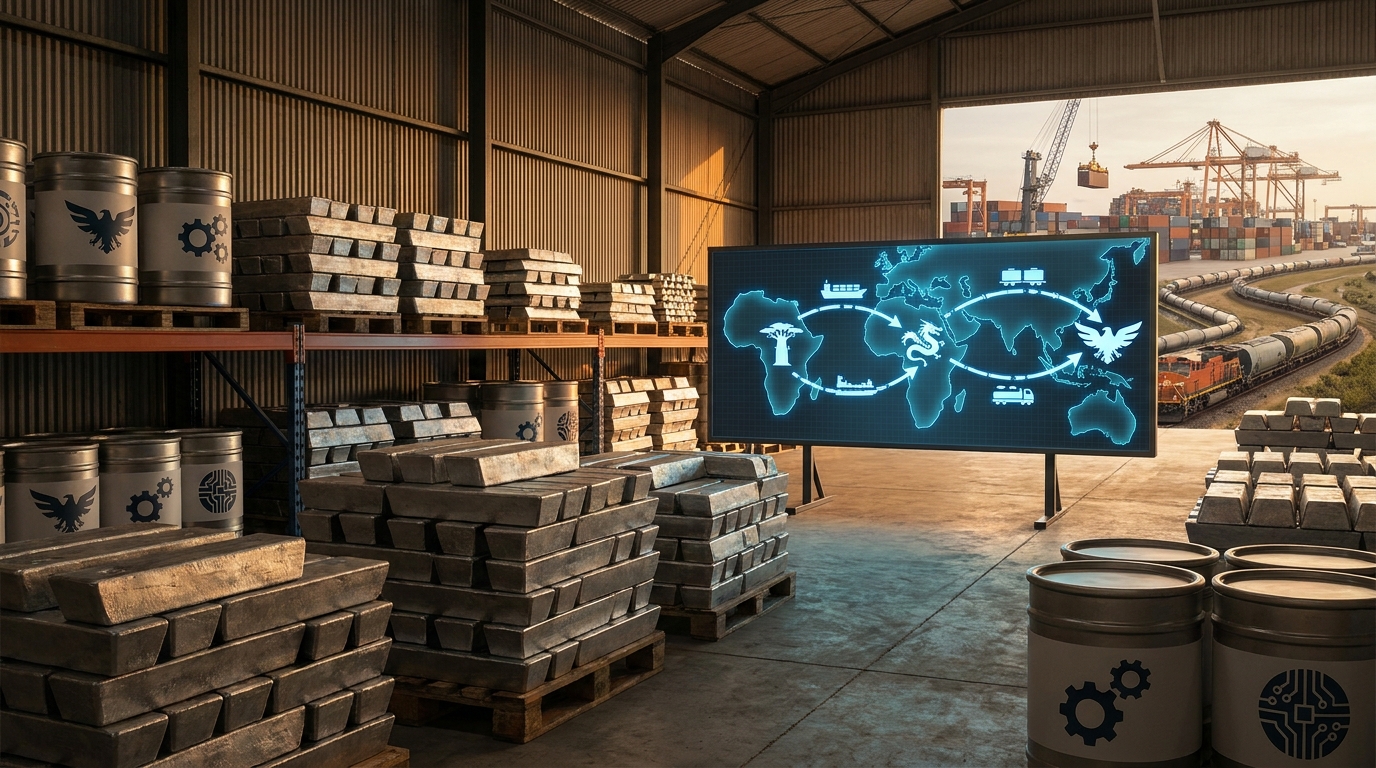
Logistics complete the picture. The source package highlights the Lobito Corridor and African mine-linked flows that could support diversification. That matters, but rail and port access solve only part of the problem. Concentrates, hydroxides, oxides, and refined metals each travel differently, carry different insurance and handling requirements, and feed different qualification cycles once they arrive. A three- to six-month disruption in magnet or cooling-component supply can emerge even when mine output remains stable, simply because the refining slot, shipping lane, or downstream machining capacity disappears.

- Material stage: concentrate, oxide, salt, metal, alloy, magnet, or finished component.
- Purity and qualification: 5N-class metal, battery-grade salt, magnet-grade alloy, or customer-approved component history.
- Processing jurisdiction: where the last transformative step occurred and whether tolling or transshipment obscures origin.
- Operational logistics: shipping mode, storage compatibility, re-assay requirements, and substitution risk during hardware refresh cycles.
This is industrial continuity, not a capital-markets story. The financing architecture around a stockpile matters because it determines who can keep production lines moving when export controls tighten, refining queues lengthen, or high-purity material disappears from the spot market.
Observed Operating Configurations and Their Trade-Offs
Current market behavior points to three operating configurations rather than one clean solution. The first is interim buffering of China-refined metal while non-Chinese mine supply is assembled upstream. This structure offers the fastest continuity benefit because the material is already near end-use form. Its weakness is obvious: policy dependence declines more slowly than public language suggests.
The second configuration is buffering at the intermediate stage outside China, using mine-linked supply from Africa, Australia, or North America and sending it into emerging refining hubs in allied jurisdictions. This model improves strategic diversification, but it is exposed to the slowest part of the learning curve: commissioning, yield stabilization, impurity control, and downstream qualification. The timeline gap between a refinery opening and a hardware buyer treating that refinery as interchangeable with an incumbent supplier is rarely short.
The third configuration is component-level buffering. In data centers, that can mean stocking rare-earth-bearing cooling subsystems, pump assemblies, or selected power modules rather than only storing raw materials. In battery systems, it can mean securing cells or modules rather than relying entirely on chemical inventories. This approach often provides the clearest continuity for deployment schedules, but it narrows flexibility and raises obsolescence risk as platform designs evolve.
The research materials for this brief also suggest that access may increasingly flow through partnership structures, preferred offtakes, or strategic procurement alliances. If that pattern holds, larger platform operators or industrial partners may gain earlier access to stockpile-supported material, while smaller downstream buyers face tighter allocation windows. That does not change the chemistry. It changes the queue.
Here the Project Vault paradox becomes fully visible. Near-term stockpiling from China-linked refining circuits can reduce immediate hardware disruption. Long-term diversification requires a different geography of chemistry, engineering, waste treatment, and qualification. Those two horizons are not mutually exclusive, but they are often presented as if they were the same task. They are not.
Note on Procyon methodology Procyon evaluates this issue by crossing policy-text monitoring, including export-control and trade signals from bodies such as BIS and, where relevant, MOFCOM, with the market and logistics indicators contained in the supplied research package. That evidence is then tested against the technical specifications of end uses, including purity class, qualification status, component architecture, and substitution limits in semiconductors, data centers, batteries, and defense-adjacent systems.
Selected Sources Referenced in the Briefing Materials
- U.S. Geological Survey, Mineral Commodity Summaries 2026 and Germanium Statistics.
- U.S. Bureau of Industry and Security, gallium and germanium export control materials cited in the briefing package.
- Ivanhoe Mines, Kipushi technical materials cited in the briefing package.
- Semiconductor Industry Association supply-chain materials cited in the briefing package.
- 5N Plus expansion materials cited in the briefing package.
- Vertiv and related data-center minerals references cited in the briefing package.
- Cobalt Institute logistics references cited in the briefing package.
- EXIM Project Vault terms referenced in the briefing package.
- IEA Critical Minerals Market Review 2026 as cited in the briefing package.
Conclusion
Project Vault exposes a supply-chain truth that is easy to miss in headline debate: security of supply is determined less by the flag over the mine than by the qualified midstream that turns by-product chemistry into usable industrial input. Until non-Chinese refining reaches commercial scale in gallium, germanium, NdPr, cobalt precursors, and related materials, a U.S. critical minerals stockpile may continue to depend partly on material whose last decisive processing step occurred in China or in China-linked Asian circuits. Procyon reads that as a resilience and continuity-of-operations problem defined by purity, qualification, compliance, and logistics, with the next phase shaped by active monitoring of weak signals across export controls, refinery commissioning, qualification cycles, and hardware bill-of-materials redesign.