In critical minerals supply chains, the failure often appears after the material is already in storage. A lot carries an assay but lacks chain-of-custody records. A rare earth oxide drum shows TREO, or total rare earth oxides, yet says little about the usable NdPr share. A pallet of NdFeB magnets is physically present but not commercially interchangeable because the grade, coating, dimensions, and magnetic properties were qualified for a different motor platform. Public stockpile policy has increasingly focused on this gap between physical presence and operational usability. For family offices, strategic metals investors, private wealth advisors, and physical commodity buyers, the central lesson is methodological: critical minerals stockpiling works only for a narrow set of materials and forms.
- Material form usually matters more than the metal name; metal, oxide, carbonate, alloy, powder, and magnet each carry different custody risks.
- Stable exchange-recognized metals fit standard strategic metals storage far better than specification-heavy intermediates and components.
- A rare earth stockpile becomes less fungible as it moves from oxide to alloy to finished magnet, where qualification and traceability dominate.
- Graphite, battery materials, and specialized alloys often rely on industry-held rotation because warehouse custody alone does not preserve commercial usability.
The stockpile question starts with form, not with name
A critical minerals reserve is often discussed as if each metal were a single warehouseable product. In practice, the product definition changes the risk profile. Copper cathode and aluminum ingot are understood globally, with exchange-linked grades, common storage methods, and broad industrial recognition. By contrast, a “rare earth” position can mean mixed concentrate, mixed carbonate, separated oxide, metal, master alloy, or finished magnet. Each step narrows the pool of acceptable counterparties and raises the documentation burden.
The same issue appears across other materials. Graphite can mean flake concentrate, purified spherical graphite, synthetic graphite, or a shaped anode precursor. Lithium expressed in LCE, or lithium carbonate equivalent, is useful for comparing contained lithium across products, but LCE does not turn a material into a warehouse-ready commodity. Contamination thresholds measured in ppm, or parts per million, can determine whether a lot works in a battery, magnet, alloy, or semiconductor context. A parcel measured in MT, meaning metric tonnes, can look substantial on paper while remaining commercially narrow if the form is wrong.
A practical review perimeter for critical minerals stockpiling
Observed stockpile reviews usually revolve around five dimensions. The first is physical stability: whether the material tolerates standard warehouse conditions, remains intact over multi-year holding periods, and avoids meaningful degradation if protected from moisture. The second is specification transparency: whether the market recognizes a common grade or whether each lot requires application-specific qualification. The third is documentation: assay certificates, safety data, origin records, title documents, packaging records, and handling history. The fourth is transferability: whether another industrial holder, merchant, or warehouse network recognizes the material without extensive requalification. The fifth is jurisdictional exposure: export controls, customs classification, sanctions screening, and origin-sensitive trade restrictions.
Public policy debates in the United States, Europe, Japan, and other industrial jurisdictions increasingly distinguish between stockpiling a stable metal and maintaining access to a specialized input. That distinction is useful in private physical metals allocation design because the apparent resilience of a stored lot can disappear when one of these five dimensions fails.

Which strategic metals are practical to store physically
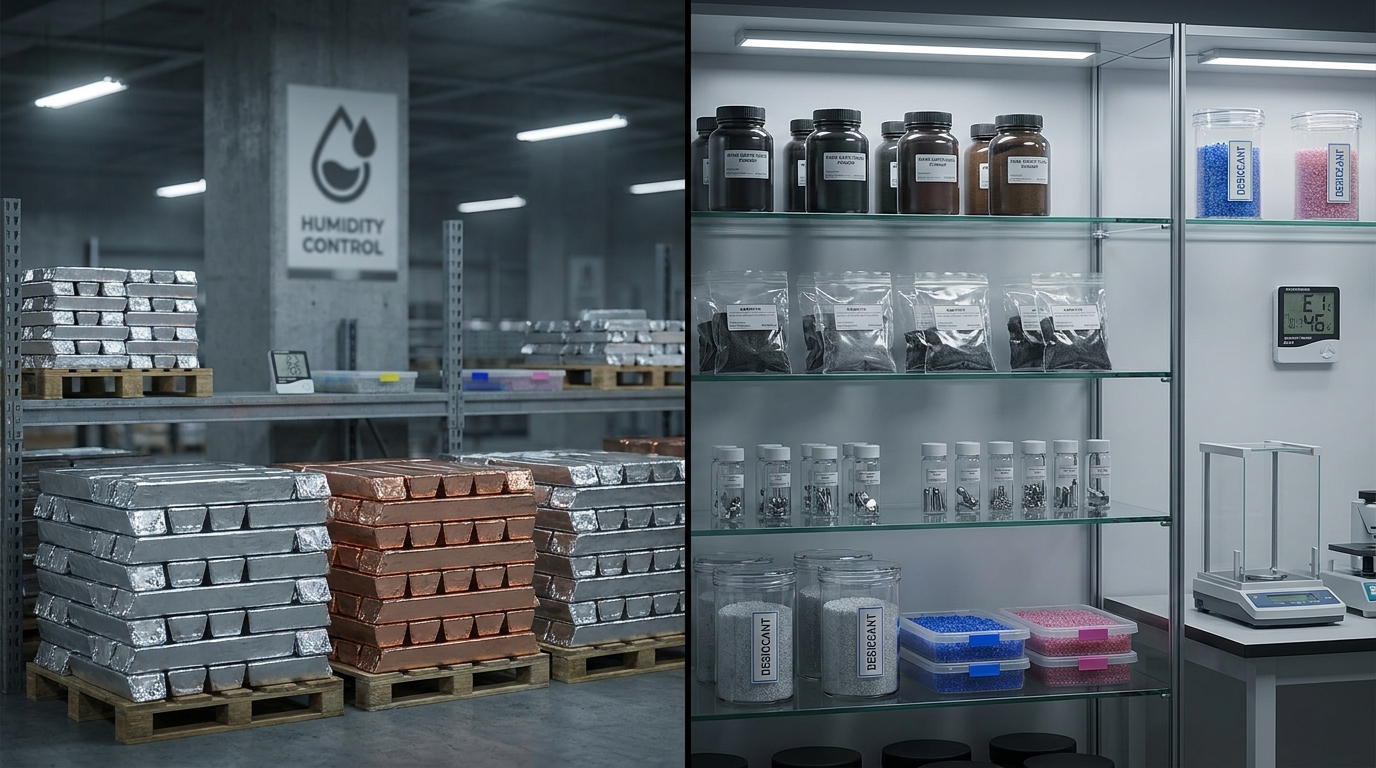
The materials that most closely resemble conventional warehouse holdings share a familiar pattern. They tolerate standard warehouse conditions with limited environmental control, do not degrade significantly when kept dry, have recognized grading systems linked to LME or COMEX style market practice, and circulate through secondary markets without end-user-specific qualification. In this group sit exchange-recognized base metals and certain refined forms used broadly across industry.
Commodity-like metals are not risk free, but the main risks are comparatively legible: title integrity, warehouse controls, moisture protection, insurance scope, and assay verification. Storage records are intelligible to a wide set of downstream participants. The material can also move between warehouses, merchants, and industrial users without the same degree of technical reinterpretation that characterizes specialty intermediates. In critical minerals stockpiling, that combination of physical stability and commercial legibility is what makes a material practical to hold.
Why a rare earth stockpile becomes harder downstream
Rare earths illustrate the difference between tonnage and usability. A concentrate may show attractive TREO, yet the value of the lot depends on the separable mix, impurity profile, and the availability of downstream separation and metal-making capacity. A separated NdPr oxide lot is more defined, but still not interchangeable in the way a standard base metal product is. Moisture management, packaging integrity, assay quality, and origin records matter immediately. At the magnet stage, fungibility drops further. Finished NdFeB magnets are shaped parts with specific grades, coatings, tolerances, and application histories. A warehouse pallet that fits one e-motor program may be irrelevant to another.
That is why the phrase rare earth stockpile can be misleading. Upstream forms are broader and easier to store, but less directly usable. Downstream forms are closer to industrial need, but more exacting in custody and qualification. In practice, the stockpile design challenge is not simply “how much rare earth material exists,” but “which form exists, under which documents, and for which consuming process.”
Graphite and specialized materials: custody becomes part of the product
Graphite often appears warehouse-friendly because it is a carbon material that can sit in bags, supersacks, or drums. The operational picture is narrower. Flake size distribution, ash content, metallic impurities, purification route, and shaping process all determine end use. A lot described loosely as battery graphite can remain unusable without particle-size data, tap density, impurity analysis, and process history. Synthetic graphite brings a different chain of evidence linked to feedstock and thermal processing. In both cases, the custody design is inseparable from the commercial identity of the product.
The same pattern extends to specialized alloys, powders, salts, and coated materials. Hygroscopic intermediates can absorb moisture. Fine powders can cake, oxidize, or become handling-sensitive. Alloy chemistry that is adequate for one melt shop may fall outside another plant’s accepted range. In these materials, physical storage is only one layer of resilience. Rotation, re-assay, packaging controls, and end-user alignment often determine whether the lot remains usable.
Failure modes observed in physical stockpiling
- Wrong form risk: the stockpile exists in concentrate, carbonate, or powder form while the downstream user needs metal, alloy, or finished component.
- Specification opacity: the assay is broad, but the consuming plant requires narrow ppm impurity thresholds or process-specific test data.
- Documentation gaps: chain-of-custody records, origin documents, safety data, or packaging history are missing or inconsistent.
- Environmental drift: moisture ingress, oxidation, coating failure, or packaging breakdown changes the condition of the material in storage.
- Qualification mismatch: the lot is real and available, but not already recognized by the industrial user or plant quality system.
- Jurisdictional friction: export licensing, customs treatment, sanctions screening, or origin restrictions interfere with movement even when inventory exists.
Can family offices stockpile critical minerals
Family offices can hold physical critical minerals in legal and operational terms, but suitability varies sharply by material class. Where the product is commodity-like, warehouse custody can function as a relatively legible storage model. Where the product is specification-heavy, the holding begins to resemble industrial inventory management rather than passive storage. That distinction matters because public stockpile policy is often designed around national resilience, while private holdings live or fail on the quality of their custody architecture, paperwork, and transferability to an actual user.
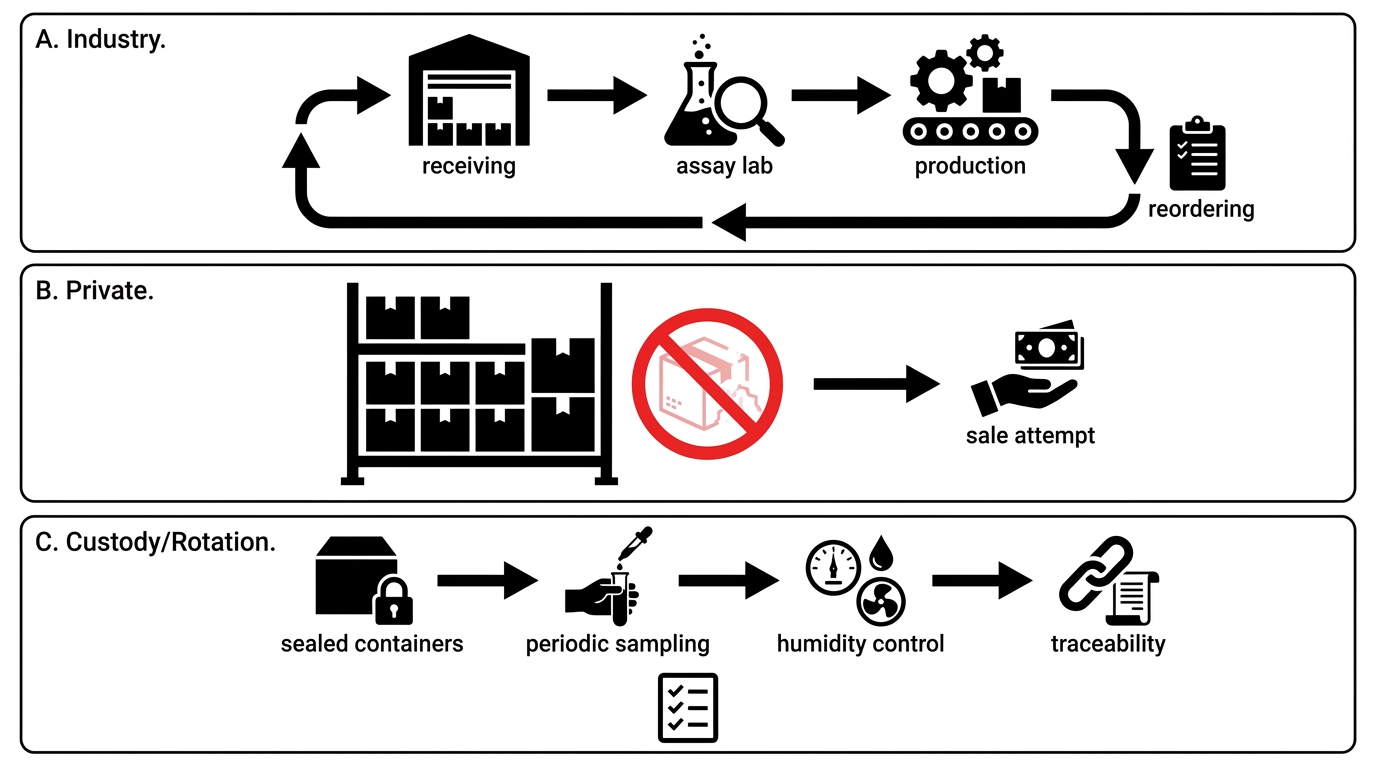
Observed private and semi-private models generally fall into three categories. The first is passive custody for stable, exchange-recognized metals. The second is segregated custody with strict assay and documentation controls for defined intermediates. The third is industry-held rotation, where the material remains inside a manufacturing or merchant ecosystem and is refreshed through normal industrial movement. The third model often appears in graphite, battery intermediates, rare earth alloys, and magnets because rotation preserves qualification in a way that static storage often does not.
Which strategic metals are practical to store physically
A workable rule of thumb emerges from public stockpile practice and warehouse observation. Materials suited to strategic metals storage tend to have broad industrial acceptance, minimal sensitivity to ordinary warehouse conditions, durable packaging formats, mature grading language, and a recognizable transfer path outside a single end use. Materials that fail one or more of those tests often rely on closer industrial custody. Magnets, graphite, specialty salts, engineered powders, and application-specific alloys frequently sit in that second group.
In that sense, what works in critical minerals stockpiling is not defined by strategic importance alone. It is defined by the overlap between physical stability, documentation quality, commercial fungibility, and downstream qualification. Public reserve policy highlights the same lesson. A stored material only counts as resilience when it can move through compliance checks and into use without being redefined, requalified, or materially reprocessed first.
For teams mapping a critical minerals reserve, a rare earth stockpile, or broader physical metals allocation questions, Procyon’s physical strategic metals due diligence checklist is available upon request.